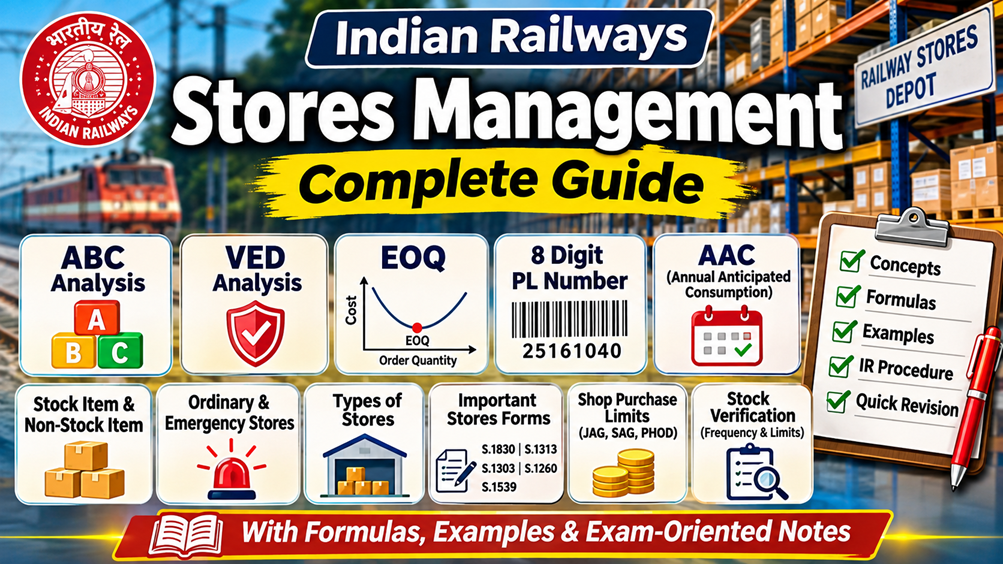
Stores Management is much more than purchasing and keeping materials in a warehouse. In Indian Railways, it is a complete system of planning, procurement, inventory control, preservation, issue, accounting and disposal of materials.
For your Railway Stores and Accounts preparation, I've put together a comprehensive learning blog covering ABC Analysis and other important inventory-control techniques, along with practical examples, formulas, Railway applications and examination points.
Railway Stores | Material Management | Departmental Examination Notes
Stores Management means systematic management of materials from the stage of identifying requirements to their final issue or disposal.
In simple words:
Right Material + Right Quantity + Right Quality + Right Time + Right Place + Right Cost
These are the fundamental principles of material management.
Main objectives
Ensure uninterrupted availability of materials.
Avoid overstocking and understocking.
Minimise investment in inventory.
Reduce storage and carrying costs.
Prevent deterioration, pilferage and wastage.
Ensure proper receipt, inspection and issue.
Maintain accurate stock records.
Identify and dispose of surplus, obsolete and scrap materials.
Ensure transparency and accountability in procurement.
Indian Railways' material management framework covers procurement, inventory control, warehousing, transportation, codification, standardisation and disposal.
2. Inventory — Meaning and Types
Inventory means materials held in stock to meet future requirements.
Examples in Railways:
Railway track materials
Electrical cables
Bearings
Brake components
Lubricants
Tools and equipment
Machinery spares
Office stationery
Types of inventory
Type | Meaning |
|---|---|
Raw Materials | Materials used in production |
Work-in-Progress | Partially completed materials |
Finished Goods | Completed products |
Consumables | Items consumed during operations |
Spare Parts | Components used for maintenance |
Safety Stock | Additional stock for unexpected demand |
Pipeline Stock | Material ordered or in transit |
3. Inventory Control — Why is it necessary?
Inventory control means maintaining the required quantity of materials at the right time while avoiding unnecessary investment.
Two situations must be avoided:
Too little stock
Production disruption
Maintenance delays
Emergency purchases
Stock-out
Too much stock
Capital blockage
Storage cost
Deterioration
Obsolescence
The objective is to maintain an optimum inventory level.
4. ABC Analysis — Always Better Control (Memory Trick)
Meaning
ABC Analysis is a technique of inventory control based on the annual consumption value of materials.
It is based on the Pareto Principle (80:20 principle).
The principle states that a relatively small proportion of items accounts for a large proportion of the total consumption value.
Formula
Classification
Category | Approx. share of items | Approx. share of annual consumption value |
|---|---|---|
A | 10% | 70% |
B | 20% | 20% |
C | 70% | 10% |
These are illustrative proportions; actual classification depends on the organisation's data and adopted limits.
A Category
Small number of items.
Accounts for the highest consumption value.
Requires strict control.
Frequent review and close monitoring.
Senior management attention.
B Category
Moderate number of items and value.
Requires moderate control.
Periodic review.
Middle-level management supervision.
C Category
Large number of items.
Accounts for a small share of consumption value.
Simple control procedures.
Less frequent review may be sufficient.
Example
Suppose a Railway Depot has annual material consumption of ₹10 crore.
Category | Consumption value |
|---|---|
A | ₹7 crore |
B | ₹2 crore |
C | ₹1 crore |
Total | ₹10 crore |
Remember: ABC is based on annual consumption value, NOT the criticality of material.
Advantages
Helps concentrate management attention.
Reduces unnecessary inventory investment.
Improves purchasing control.
Helps prioritise stock verification.
Improves inventory efficiency.
5. VED Analysis — Vital, Essential, Desirable
VED Analysis classifies inventory according to the criticality or importance of an item in its end use.
Unlike ABC, it is not based on monetary value.
Classification
Category | Meaning | Explanation |
|---|---|---|
V | Vital | Non-availability may seriously affect operations or safety |
E | Essential | Important, but temporary non-availability may be manageable |
D | Desirable | Non-availability does not seriously affect operations |
Example
Vital: A critical locomotive component whose absence can stop operations.
Essential: A maintenance component for which a temporary alternative or delay is manageable.
Desirable: A non-critical workshop accessory.
Control
Vital items: Highest priority; ensure availability.
Essential items: Moderate safety stock and periodic review.
Desirable items: Economical stocking and controlled procurement.
Exam point: VED is based on criticality, whereas ABC is based on annual consumption value.
6. FSN Analysis — Fast, Slow, Non-Moving
Meaning
FSN Analysis classifies materials based on their movement or frequency of issue/consumption.
Category | Meaning | Explanation |
|---|---|---|
F | Fast Moving | Frequently issued items |
S | Slow Moving | Issued occasionally |
N | Non-Moving | No issue or movement during the defined review period |
Example
Material | Classification |
|---|---|
Regularly issued nuts and bolts | F |
Occasionally required special bearings | S |
Unused spare for discontinued equipment | N |
Importance
Identifies dead and inactive stock.
Prevents unnecessary procurement.
Helps identify obsolete materials.
Supports disposal of surplus stock.
Improves warehouse utilisation.
Exam point: FSN is based on the movement/issue pattern, not the price of the material.
7. HML Analysis — High, Medium, Low
Meaning
HML Analysis classifies materials according to their unit price or individual item cost.
Category | Meaning | Control |
|---|---|---|
H | High Cost | Strict purchase and custody control |
M | Medium Cost | Moderate control |
L | Low Cost | Simplified control |
Example
High-cost machinery component → H
Medium-cost tool → M
Low-cost stationery → L
Why is it important?
A material may have low annual consumption but a very high individual price.
HML helps management focus on the cost of individual units.
Difference to remember:
ABC = Annual consumption value.
HML = Unit price.
8. SDE Analysis — Scarce, Difficult, Easy
Meaning
SDE Analysis classifies materials according to their availability and difficulty of procurement.
Category | Meaning | Explanation |
|---|---|---|
S | Scarce | Extremely difficult or scarce in the market |
D | Difficult | Difficult to procure; longer procurement lead time |
E | Easily Available | Easily available in the market |
Example
Special imported railway equipment → S
Specialised electrical component → D
Ordinary nuts and bolts → E
Importance
Helps determine safety stock.
Helps identify procurement risks.
Assists in deciding advance procurement.
Helps in planning alternative sources of supply.
Exam point: SDE is based on availability/procurement difficulty.
9. XYZ Analysis — Inventory Value
Meaning
XYZ Analysis classifies items according to the value of inventory held at a particular point in time.
Category | Meaning | General interpretation |
|---|---|---|
X | High Inventory Value | High value of closing stock |
Y | Medium Inventory Value | Moderate value of closing stock |
Z | Low Inventory Value | Low value of closing stock |
Example
Suppose a depot has:
Expensive machinery spares with high closing stock value → X
Medium-value components → Y
Low-value consumables → Z
Importance
Helps control capital blocked in stock.
Helps identify high-value inventory.
Helps prioritise stock verification.
Helps reduce unnecessary holding of stock.
Important distinction:
ABC = Annual consumption value.
XYZ = Inventory value at a particular point in time.
10. GOLF Analysis — Source of Supply
Meaning
GOLF classifies materials according to their source of procurement.
Category | Meaning |
|---|---|
G | Government |
O | Ordinary |
L | Local |
F | Foreign |
Importance
Identifies the source of supply.
Helps procurement planning.
Helps analyse import dependency.
Assists in identifying alternative suppliers.
11. SOS Analysis — Seasonal and Off-Seasonal
Meaning
SOS Analysis classifies materials according to their seasonal requirement or demand pattern.
Category | Meaning |
|---|---|
Seasonal | Required during a particular season |
Off-Seasonal | Required outside the main season or during other periods |
Example
Materials required for monsoon-related maintenance may have seasonal demand.
Importance
Helps advance procurement.
Avoids shortage during peak demand.
Prevents unnecessary stock accumulation after the season.
Helps plan storage requirements.
12. Comparison of All Inventory Analysis Methods
Analysis | Full form | Basis of classification |
|---|---|---|
ABC | A, B, C | Annual consumption value |
VED | Vital, Essential, Desirable | Criticality |
FSN | Fast, Slow, Non-moving | Movement/issue frequency |
HML | High, Medium, Low | Unit price |
SDE | Scarce, Difficult, Easy | Availability |
XYZ | X, Y, Z | Inventory holding value |
GOLF | Government, Ordinary, Local, Foreign | Source of supply |
SOS | Seasonal, Off-seasonal | Seasonal demand |
Easy memory technique
Remember what each analysis asks:
ABC — How much do we consume in value?
VED — How important is the item?
FSN — How frequently does it move?
HML — How expensive is one unit?
SDE — How difficult is it to procure?
XYZ — How much money is lying in stock?
GOLF — From where do we procure?
SOS — When do we need it?
13. Combined ABC–VED Analysis
This is a particularly useful concept because ABC alone cannot identify criticality.
Suppose:
A costly spare is readily available.
A cheap spare is essential for the operation of a locomotive.
ABC may give priority to the expensive item, but VED may give priority to the cheap, critical item.
Therefore, both analyses should be considered together.
ABC–VED Matrix
Vital (V) | Essential (E) | Desirable (D) | |
|---|---|---|---|
A | AV | AE | AD |
B | BV | BE | BD |
C | CV | CE | CD |
Interpretation
AV: High consumption value + vital. Highest attention.
AE: High consumption value + essential.
AD: High consumption value + desirable.
CV: Low consumption value + vital. May still need assured availability.
CD: Low consumption value + desirable. Generally lower priority.
The matrix helps balance financial importance with operational criticality.
Remember: A low-value item can still be vital. Never decide stocking policy using ABC alone.
14. Other Important Concepts of Stores Management
Inventory classification is only one part of stores management. The following concepts are equally important for Railway Stores and departmental examinations.
A. Economic Order Quantity (EOQ)
Meaning
EOQ is the quantity of material that should be ordered at one time to minimise the total ordering and inventory carrying costs.
Formula
Where:
D = Annual demand in units
S = Ordering cost per order
H = Annual holding cost per unit
Example
Suppose:
Annual demand = 10,000 units
Ordering cost = ₹100 per order
Holding cost = ₹2 per unit per year
Advantages
Minimises ordering and carrying costs.
Helps determine economical order quantity.
Reduces unnecessary ordering.
Improves inventory planning.
Exam point: EOQ determines how much to order, not when to order.
B. Reorder Level / Reorder Point
Meaning
Reorder Level is the stock level at which a fresh purchase order should be initiated.
Formula
This is a commonly used conservative formula where the organisation applies maximum consumption and maximum lead time.
Example
Maximum daily consumption = 20 units.
Maximum lead time = 10 days.
Reorder Level = 200 units.
When stock reaches the reorder level, fresh procurement action should be initiated.
C. Minimum Stock Level
Minimum Stock Level is the lowest desirable stock level to be maintained, considering operational requirements and procurement lead time.
A commonly used textbook formula is:
D. Maximum Stock Level
Maximum Stock Level is the upper limit beyond which stock should not ordinarily be allowed to rise.
The precise formula used should follow the applicable departmental stocking policy.
E. Safety Stock / Buffer Stock
Safety Stock means additional stock maintained to meet unexpected situations.
Examples:
Sudden increase in consumption.
Delay in supplier delivery.
Transport disruption.
Emergency maintenance requirements.
Remember: Safety Stock protects against uncertainty in demand and lead time.
F. Lead Time
Lead Time is the period between placing an order and receiving the material in usable condition.
It may include:
Purchase order processing.
Supplier manufacturing/preparation.
Dispatch.
Transportation.
Receipt and inspection.
Longer lead time generally requires greater attention to safety stock and advance procurement.
G. Economic Procurement vs Emergency Procurement
Normal procurement | Emergency procurement |
|---|---|
Planned in advance | Arises from urgent requirement |
Regular procurement procedure | Applicable emergency procedure |
Generally allows competition | May involve permitted exceptional arrangements |
Supports economical purchasing | Supports continuity of operations |
Emergency procurement must still comply with applicable financial and procurement rules.
15. Inventory Turnover Ratio (ITR)
Meaning
Inventory Turnover Ratio indicates how efficiently inventory is being consumed or issued during a period.
Formula
Where:
Example
Annual consumption = ₹12 crore.
Opening stock = ₹3 crore.
Closing stock = ₹1 crore.
Average inventory:
Inventory Turnover Ratio:
Interpretation
Higher turnover generally indicates faster movement and less capital tied up in inventory, but excessively low stock may increase the risk of shortages.
Important: Do not confuse Inventory Turnover Ratio with Turnover Period or Stores Turnover Ratio. Check the exact formula specified in the relevant Railway manual or departmental report.
16. Stock Verification
Stock Verification means physically checking the stock available in the depot and comparing it with the book balance.
Objectives
Verify physical stock.
Identify shortages and excesses.
Detect pilferage.
Identify damaged materials.
Identify obsolete and surplus stock.
Ensure accuracy of stock records.
Types
Annual verification.
Periodical verification.
Surprise verification.
Special verification.
Stock verification is an important internal control mechanism.
Stock discrepancy
Suppose:
Book Balance = 100 units.
Physical Balance = 95 units.
Difference = 5 units short.
This shortage must be investigated and dealt with under the applicable procedure.
17. FIFO and FEFO
FIFO — First In, First Out
The material received first is issued first.
Useful for:
General consumables.
Materials where ageing can affect usability.
Maintaining orderly stock rotation.
FEFO — First Expiry, First Out
Material having the earliest expiry date is issued first.
Useful for:
Chemicals.
Medicines.
Expiry-sensitive materials.
Difference: FIFO is based on receipt date; FEFO is based on expiry date.
18. Codification and Standardisation
These concepts connect directly with your earlier topic of PL Numbers.
Codification
Codification means assigning a unique identification code to each material.
In Indian Railways, PL Numbers are used for identifying stock items.
Advantages:
Avoids duplication.
Provides uniform identification.
Reduces confusion.
Helps computerised inventory management.
Facilitates procurement and accounting.
Standardisation
Standardisation means reducing unnecessary varieties and adopting common specifications wherever possible.
Example:
If five departments use different specifications of essentially the same nut or bolt, standardisation may reduce unnecessary varieties.
Variety Reduction
It means eliminating unnecessary variations in materials and specifications.
Remember:
Codification = Unique identification.
Standardisation = Common specifications.
Variety Reduction = Reduction of unnecessary varieties.
19. Surplus, Obsolete and Scrap Materials
These are three different concepts.
Term | Meaning |
|---|---|
Surplus | Material exceeding foreseeable requirements |
Obsolete | Material no longer required due to technological change or discontinuation |
Scrap | Material having no further normal service use in its existing condition, but potentially having disposal value |
Examples
Surplus: Excess stock of a frequently used component.
Obsolete: Spare for an equipment model permanently discontinued.
Scrap: Unusable metal parts recovered from maintenance work.
Why is disposal important?
Releases blocked capital.
Frees warehouse space.
Reduces preservation costs.
Prevents deterioration.
Helps recover value through disposal.
20. Just-in-Time (JIT) Inventory
Meaning
JIT is a method in which material is procured or received close to the time when it is required.
Objectives
Reduce inventory holding.
Reduce storage costs.
Avoid excess stock.
Improve inventory efficiency.
Disadvantages
Heavy dependence on suppliers.
Vulnerability to transport delays.
Risk of operational interruption.
Less protection against unexpected demand.
Railway application: JIT may be suitable for predictable, readily available items, but critical safety and operational spares require appropriate availability safeguards.
21. Two-Bin System
A simple inventory control technique.
The stock is divided into two bins:
First Bin: Normal working stock.
Second Bin: Reserve stock for use during replenishment lead time.
When the first bin becomes empty, fresh procurement is initiated and the second bin is used.
It is useful for relatively low-value, regularly consumed materials.
22. Perpetual Inventory System
A system in which receipts, issues and balances are continuously recorded.
Features
Continuous stock recording.
Regular reconciliation.
Better stock visibility.
Early identification of discrepancies.
Important records
Bin Card.
Stock Ledger.
Receipt documents.
Issue documents.
Stock verification records.
Difference:
Physical stock verification checks actual stock; perpetual inventory maintains continuous records of stock movements.
23. Stores Procurement Cycle in Indian Railways
Understand the complete procurement cycle:
Identification of Requirement
User department identifies the requirement of material.
Demand Preparation
Quantity, specification and requirement are assessed.
Availability of Budget
Financial provision and procurement authority are checked.
Procurement
Tendering or other permitted procurement method is adopted.
Purchase Order
Order is placed with the selected supplier.
Receipt of Material
Material is received at the nominated depot.
Inspection and Acceptance
Quality and quantity are checked.
Stock Accounting
Receipt is entered into the relevant records/system.
Storage and Preservation
Material is stored safely.
Issue to User Department
Material is issued against an authorised requirement.
Accounting and Verification
Transactions are reconciled and stock is verified.
Important Railway IT systems
System | Purpose |
|---|---|
IREPS | Railway e-procurement |
IMMS | Integrated Materials Management System for stock items |
UDM | User Depot Module for non-stock items |
These systems support digital procurement and material management in Indian Railways.
24. Important Formulas — One-Page Revision
Concept | Formula |
|---|---|
Annual Consumption Value | Annual Quantity × Unit Price |
EOQ | \(\sqrt{2DS/H}\) |
Reorder Level | Maximum Consumption × Maximum Lead Time |
Average Inventory | (Opening Stock + Closing Stock) / 2 |
Inventory Turnover Ratio | Annual Consumption Value / Average Inventory |
Minimum Stock | Reorder Level − Normal Consumption during Normal Lead Time |
Maximum Stock | Reorder Level + EOQ − Minimum Consumption during Minimum Lead Time |
25. ABC vs VED vs FSN vs XYZ — Most Important Differences
Basis | ABC | VED | FSN | XYZ |
|---|---|---|---|---|
What is measured? | Consumption value | Criticality | Movement | Stock value |
Main objective | Financial control | Operational continuity | Movement control | Capital control |
Main concern | Money spent | Importance | Speed of issue | Money held in stock |
Typical focus | A items | V items | N items | X items |
26. My Recommended Study Priority
For Railway Stores and Accounts departmental examinations, I would study in this order:
Priority | Topic |
|---|---|
Very High | ABC, VED, FSN Analysis |
Very High | EOQ, Reorder Level, Minimum & Maximum Stock |
Very High | PL Number and Codification |
Very High | Stock Verification |
High | HML, SDE, XYZ, GOLF, SOS |
High | Surplus, Obsolete and Scrap |
High | Procurement and Receipt of Materials |
High | IREPS, IMMS and UDM |
Additional | JIT, FIFO, FEFO, Two-Bin System |
My final recommendation: Do not study ABC, VED, FSN and other analyses as isolated definitions. Understand that each method answers a different management question:
ABC controls expenditure.
VED protects operational continuity.
FSN controls movement and identifies inactive stock.
HML controls unit-cost exposure.
SDE controls procurement risk.
XYZ controls the value of stock held.
Together, they help a Stores Department maintain the right inventory with minimum cost and maximum operational availability.
26. Most Important Examination Questions
Try answering these without looking at the notes.