A Complete Guide to Price List, Codes, Forms and Inventory Management
Know the Codes • Understand the Numbers • Manage Stores Better
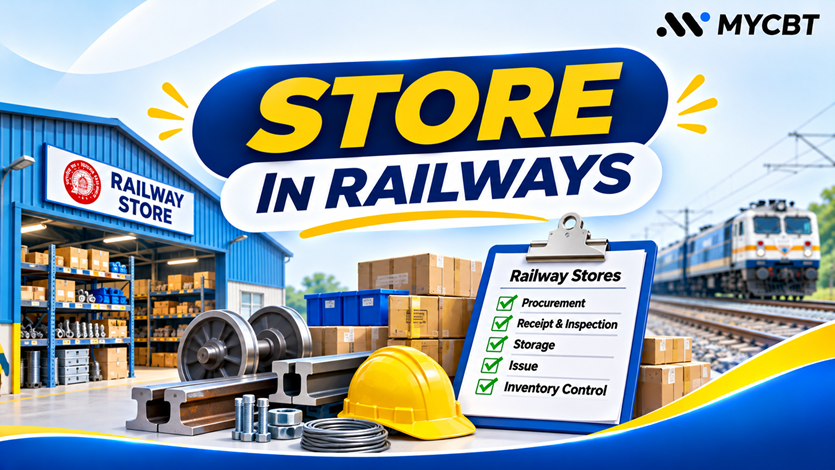
Railway Stores is one of the most important support systems behind the smooth operation and maintenance of Indian Railways. Every locomotive, coach, wagon, signalling system, electrical installation, workshop and maintenance activity requires materials—and those materials have to be identified, procured, received, stored, issued, accounted for and periodically verified.
For a new employee or someone preparing for a Railway departmental examination, the terminology used in Stores can initially appear complicated.
Terms such as Price List Number (PL No.), AAC, S-1830, S-1313, S-1260, ABC Analysis, VED Analysis, EOQ and MSOP are frequently encountered.
This article explains these concepts in simple language.
1. What is Railway Stores?
The Stores Department is responsible for ensuring that the required materials are available:
In the right quantity
At the right time
At the right place
At the right quality
At an economical cost
The objective is not simply to keep a large quantity of material in a warehouse.
The real objective is:
To maintain uninterrupted supply while keeping inventory and procurement costs under control.
Railway Stores therefore combines procurement, inventory control, warehousing, issue, accounting, inspection, stock verification and disposal.
Indian Railways uses a structured system of material identification and inventory management for this purpose.
2. What is a Price List Number (PL Number)?
A Price List Number, commonly called a PL Number, is the identification number allotted to a store item.
Each stock item is assigned a unique number so that the item can be identified consistently across the railway stores system.
A commonly used Railway Stores coding structure is an eight-digit semi-significant code:
AA BB CCC D
Where:
| Part | Digits | Meaning |
|---|---|---|
| A | 1st–2nd | Main Group |
| B | 3rd–4th | Sub-Group |
| C | 5th–7th | Serial Number of item |
| D | 8th | Check Digit |
The first two digits therefore indicate the main group, while the third and fourth digits indicate the sub-group. The final digit has a special computer/checking significance.
Example
Suppose a PL Number is:
30 01 035 4
It can be read conceptually as:
30 → Main Group
01 → Sub-Group
035 → Serial number
4 → Check digit
The exact nomenclature and group allocation must always be checked against the applicable Railway Price List/Nomenclature records.
3. What is the Check Digit?
The last digit of the PL Number is called the check digit.
Its purpose is to help detect errors in entering or transmitting the PL Number.
The Railway Stores coding system uses a checking mechanism based on modulus 11. In the commonly illustrated method, digits are assigned positional weights, the products are added, and the remainder obtained by division by 11 is used as the check digit.
Why is it important?
Imagine a store employee enters:
30851116
instead of the correct PL Number.
A check-digit system can help identify whether the entered number is mathematically consistent.
Therefore, the check digit provides an additional layer of protection against:
Wrong item selection
Wrong ledger posting
Wrong procurement
Wrong issue
Data-entry errors
4. What is AAC?
AAC = Average Annual Consumption / Anticipated Annual Consumption
Both expressions are encountered in Railway Stores material, and the exact meaning depends on the context.
In inventory and procurement discussions, AAC is used to determine the expected requirement of materials over a year. CAG material, for example, uses AAC as Average Annual Consumption, while Railway training material also uses Anticipated Annual Consumption in the context of annual requirement planning.
Why is AAC important?
AAC helps Railway Stores estimate:
How much material may be required
Procurement quantity
Stocking requirements
Imprest requirements
Budget requirements
Tender quantities
For example, if a depot expects to consume approximately:
1,200 bearings per year
then the annual requirement has to be considered while planning procurement and inventory.
Important point
AAC should not be treated as simply "last year's consumption."
Future requirements may change because of:
Increase/decrease in traffic
New locomotives or coaches
Maintenance schedules
New projects
Change in technology
Replacement programmes
Changes in consumption pattern
Therefore, annual requirement estimation should be based on the actual operational requirement and appropriate historical/forecast information.
5. S-1830 – Imprest Stores
S-1830 is associated with the recoupment/issue schedule for imprest stores.
Imprest stores are materials kept with an authorised user or department for routine and day-to-day requirements.
Examples can include frequently required maintenance or operating materials.
The basic idea is simple:
Frequently required materials should be available near the point of use instead of being obtained from the main stores depot every time.
The requirement and replenishment of imprest items are therefore controlled through an established system.
Railway training material identifies S-1830 as the recoupment schedule for imprest stores.
Why are imprest stores useful?
Suppose a maintenance depot requires a frequently used material every day.
If every small requirement had to be obtained from the main stores depot, it would create:
Delay
Extra paperwork
Administrative workload
Operational inconvenience
Imprest arrangements keep essential routine materials available.
6. S-1313 – Requisition-cum-Issue Note
S-1313 is an important form used for stock items.
It is generally described as the Combined Requisition and Issue Note or Requisition-cum-Issue Note for stock items.
In simple terms:
User needs material → submits requisition → Stores checks availability → material is issued → transaction is recorded.
S-1313 therefore connects the indenter/user with the Stores Depot.
Training references describe S-1313 as being prepared in multiple copies so that the relevant sections—such as Accounts, Depot and Indenter—receive the required record.
Stock item vs Non-stock item
A stock item is maintained in stores because there is a recurring requirement for it.
A non-stock item is generally not maintained as regular stock and is procured against a specific requirement.
A commonly referenced Railway form for a non-stock indent is S-1302.
Important correction
If your notes say "S-1303" in connection with a normal non-stock indent, it is worth checking the source. The references I found identify S-1302 for the non-stock requisition, not S-1303.
7. S-1260 – Stock Verification Sheet
S-1260 is associated with Stock Verification.
Stock verification means comparing:
What the records say should be available
with
What is physically available in the store.
For example:
Ledger balance = 100 pieces
Physical count:
Actual balance = 97 pieces
There is a shortage of:
3 pieces
Similarly, if the physical balance is 103, there is an excess of 3 pieces.
The stock verification sheet records the relevant details and discrepancies.
The Railway Stores Code material states that stock verification sheets are prepared in Form S-1260, with the stock verifier recording the ground balance and the subsequent report showing book balance, ground balance and excess/shortage.
Why is stock verification important?
It helps detect:
Shortage
Excess
Wrong accounting
Misclassification
Unrecorded receipts/issues
Errors in ledger balances
Possible losses or irregularities
The fundamental objective is:
Ledger balance should agree with the physical balance, subject to properly investigated and accounted discrepancies.
8. What does "D" mean with S-1260?
The standard reference is S-1260, the Stock Verification Sheet.
Some local notes or training material may describe variants such as departmental verification or use additional notation such as S-1260(D).
The important examination concept is:
S-1260 → Stock Verification Sheet / Stock Verification Report
The Railway Stores Code specifically identifies S-1260 for stock verification.
9. S-1538 / S-1539 – Important Note
Your list mentions:
"S NOTE 1538"
Here it is important not to memorize an uncertain form number.
The Railway references I found consistently identify S-1539 in connection with certain returned/scrap/T&P disposal transactions, rather than S-1538. For example, Railway training material describes condemned T&P/scrap being sent to Stores on S-1539.
Therefore:
Check your departmental source before using "S-1538."
A useful examination association is:
S-1539 → Advice/return/disposal-related Stores transaction in the relevant context.
The exact application should be checked against the current applicable Stores Code/form instructions of the Railway concerned.
10. MSOP – Model Schedule of Powers
MSOP = Model Schedule of Powers
This is a very important concept for Railway administration.
In simple language:
MSOP tells us who has the authority to approve a particular financial or administrative action and within what delegated limits.
For example, an organisation cannot allow every employee to approve a major procurement simply because the material is required.
There must be a defined hierarchy of authority.
MSOP deals with the delegation of financial and administrative powers.
The Railway Board's Model SOP framework is intended to provide uniformity in delegation of powers across Zonal Railways, Production Units and other applicable Railway organisations.
Why is MSOP important?
It helps ensure:
Financial discipline
Accountability
Proper approval
Faster decision-making
Clear responsibility
Prevention of unauthorised expenditure
Simple example
Suppose a purchase proposal is worth ₹X.
The question is:
Who can approve it?
The answer depends upon:
Nature of expenditure
Value
Department
Delegated powers
Applicable SOP/MSOP
Financial concurrence requirements
Therefore, officers dealing with Railway Stores must know the applicable current Schedule of Powers, rather than relying on an old value limit.
11. ABC Analysis
ABC Analysis is an inventory-control technique based mainly on the annual consumption value of items.
It follows the Pareto principle: a relatively small number of items can represent a large portion of the total inventory value.
A typical conceptual classification is:
A Items
High-value items.
They require:
Close monitoring
Accurate forecasting
Strict control
Frequent review
Management attention
B Items
Medium-value items.
They require a moderate level of control.
C Items
Low-value items.
There may be many such items, but each individually has relatively low annual consumption value.
Simple example
Imagine a store has:
| Item | Annual Value | Category |
|---|---|---|
| Traction equipment | ₹50 lakh | A |
| Bearings | ₹8 lakh | B |
| Nuts & bolts | ₹50,000 | C |
The exact classification limits should be determined using the applicable analysis methodology rather than memorising one universal percentage.
Important point
ABC answers:
"Which items are financially important?"
It does not answer:
"Which items are critical to operation?"
For that, we use VED analysis.
12. VED Analysis
VED = Vital, Essential, Desirable
VED classification is based on the criticality of an item, especially its effect on operations if the item is unavailable.
V – Vital
Without the item, the system or operation may come to a serious halt.
These items require very high availability.
E – Essential
The item is important, and its absence can seriously affect operations, although an alternative or temporary arrangement may sometimes exist.
D – Desirable
The item is useful but its absence does not seriously affect the operation immediately.
ABC vs VED
This is one of the most important distinctions:
ABC = Value
VED = Criticality
For example, a small inexpensive component may cost only ₹500, but if its absence stops a critical system, it may be classified as Vital.
Therefore:
Low price does not necessarily mean low importance.
13. ABC + VED Matrix
The real power comes from combining the two methods.
For example:
| Item | ABC | VED | Management Attention |
|---|---|---|---|
| Expensive & critical | A | V | Very High |
| Expensive but less critical | A | D | High financial control |
| Cheap but critical | C | V | High availability control |
| Cheap & non-critical | C | D | Lower control |
This helps management decide where to spend maximum attention.
A ₹10 lakh item may need financial control because of its value.
A ₹100 item may need high stock availability because its absence could stop an important operation.
14. EOQ – Economic Order Quantity
EOQ = Economic Order Quantity
EOQ answers a basic inventory question:
How much should we order at one time?
Ordering too frequently increases ordering costs.
Ordering too much at one time increases inventory/holding costs.
EOQ attempts to find the quantity that balances these two costs.
The classical EOQ formula is:
Where:
D = Annual demand
S = Ordering/setup cost per order
H = Annual holding cost per unit
Thus:
EOQ = √(2DS/H)
15. Simple EOQ Example
Suppose:
Annual demand = 10,000 units
Ordering cost = ₹500 per order
Holding cost = ₹20 per unit per year
Then:
EOQ = √[(2 × 10,000 × 500) / 20]
EOQ = √500,000
EOQ ≈ 707 units
So, under the assumptions of the classical EOQ model, an order quantity of approximately 707 units would minimise the combined ordering and holding costs.
Real Railway procurement decisions can involve many additional factors, such as:
Lead time
Minimum order quantity
Tender conditions
Supplier capacity
Budget
Safety stock
Shelf life
Criticality
Delivery schedule
Contract terms
Therefore, EOQ is a decision-support model, not an automatic instruction to order exactly that quantity.
16. Difference Between AAC and EOQ
These two terms are often confused.
AAC tells us:
How much material may be required during the year.
EOQ tells us:
How much should ideally be ordered per order, considering ordering and holding costs.
Example:
Annual requirement:
10,000 units
AAC/annual demand ≈ 10,000 units.
EOQ may indicate:
707 units per order.
Then the organisation may need approximately:
10,000 ÷ 707 ≈ 14 orders
subject to practical procurement constraints.
17. Stock, Non-Stock and Imprest – Quick Difference
| Concept | Meaning |
|---|---|
| Stock Item | Regularly stocked material |
| Non-Stock Item | Material procured against a specific requirement |
| Imprest Item | Material kept with authorised users for routine requirements |
| Surplus | Material beyond current justified requirement |
| Dead/obsolete material | Material with little/no foreseeable requirement, subject to applicable rules |
The exact classification and treatment should always follow the applicable Railway Stores Code and current instructions.
18. What Happens When a User Needs a Stock Item?
A simplified process is:
Requirement arises
↓
User/Indenter prepares requisition
↓
S-1313 / applicable electronic equivalent
↓
Stores checks stock
↓
Material issued
↓
Issue transaction recorded
↓
Ledger/stock balance updated
↓
Replenishment planned when necessary
Modern Railway systems also use computerised platforms such as iMMS and UDM for stores-related activities. Railway training material describes UDM as supporting requisitioning, issue, receipt, stock verification and related material transactions.
19. What Happens When Stock is Low?
When stock falls toward the required level, the Stores organisation has to consider:
Current balance
AAC
Past consumption
Future requirement
Lead time
Safety stock
Outstanding purchase orders
Procurement cycle
Criticality
Budget availability
The objective is to avoid two opposite problems:
Stock-out
Material is unavailable when required.
This can affect maintenance and operations.
Overstocking
Too much money is blocked in inventory.
This can cause:
High carrying cost
Storage problems
Deterioration
Obsolescence
Excess/surplus stock
Good inventory management tries to maintain the right balance.
20. Stock Verification – Book Balance vs Ground Balance
This is an important concept for Railway Stores examinations.
Suppose:
Book balance = 500
Physical count:
Ground balance = 490
Then:
Shortage = 10
If:
Book balance = 500
Physical count:
Ground balance = 510
Then:
Excess = 10
The discrepancy must be investigated and dealt with according to the applicable rules.
The purpose of verification is not merely counting.
It is to establish whether:
The physical material actually agrees with the recorded balance.
S-1260 is the key form associated with this verification process.
21. Why Price List and Inventory Control Work Together
A PL Number identifies what the item is.
AAC estimates how much may be needed.
ABC tells us how financially important the item is.
VED tells us how operationally critical the item is.
EOQ helps determine an economical order quantity.
Stock verification confirms whether the physical stock matches the records.
MSOP establishes who has authority to approve the relevant action.
Together, these concepts form a connected inventory-management system.
22. Easy Way to Remember Everything
Use this memory chain:
PL → AAC → ABC/VED → EOQ → Issue → Verification → MSOP
PL Number
→ Identifies the material
AAC
→ Estimates annual requirement
ABC
→ Measures financial importance
VED
→ Measures operational criticality
EOQ
→ Helps determine economical order quantity
S-1313 / S-1830 etc.
→ Supports the relevant requisition/issue/recoupment process
S-1260
→ Supports stock verification
MSOP
→ Determines delegated authority
23. Quick Revision Table
| Term / Form | Meaning / Main Use |
|---|---|
| PL No. | Price List Number; unique identification of a store item |
| 1st–2nd digits | Main Group |
| 3rd–4th digits | Sub-Group |
| 5th–7th digits | Serial number |
| 8th digit | Check digit |
| AAC | Annual consumption/annual requirement concept |
| S-1830 | Imprest recoupment/issue schedule |
| S-1313 | Requisition-cum-issue note for stock items |
| S-1302 | Commonly referenced non-stock requisition form |
| S-1260 | Stock Verification Sheet/Report |
| ABC | Inventory classification based on consumption value |
| VED | Classification based on criticality |
| EOQ | Economic Order Quantity |
| MSOP | Model Schedule of Powers |
| S-1539 | Important Stores form used in returned/disposal-related contexts; verify current applicable procedure |
The form-number references above should be checked against the current Railway Board/Zonal Railway instructions, because forms, procedures and delegated powers can be revised.
24. Final Takeaway
Railway Stores is not simply about keeping materials inside a warehouse.
It is a complete materials-management system.
A successful Stores organisation must know:
What material is required?
→ PL Number
How much is required?
→ AAC / demand planning
How financially important is it?
→ ABC
How operationally critical is it?
→ VED
How much should be ordered?
→ EOQ and procurement planning
How is material requisitioned and issued?
→ Prescribed Stores forms/system
Does physical stock agree with the records?
→ Stock Verification / S-1260
Who can approve the action?
→ MSOP / applicable Schedule of Powers
The ultimate objective is simple:
Right Material + Right Quantity + Right Time + Right Quality + Right Cost = Efficient Railway Stores Management
When these principles work together, Railway Stores can support uninterrupted train operations while reducing excess inventory, avoiding shortages and maintaining strong financial and material accountability.
One-Line Exam Revision
PL identifies the item, AAC estimates the requirement, ABC measures value, VED measures criticality, EOQ balances ordering and holding costs, S-1313 supports stock requisition/issue, S-1830 relates to imprest recoupment, S-1260 relates to stock verification, and MSOP defines delegated authority.
Always verify the latest applicable Railway Board/Zonal Railway instructions before using a form number, financial limit or delegated power in an official transaction.