Introduction to Indian Railways Stores Management
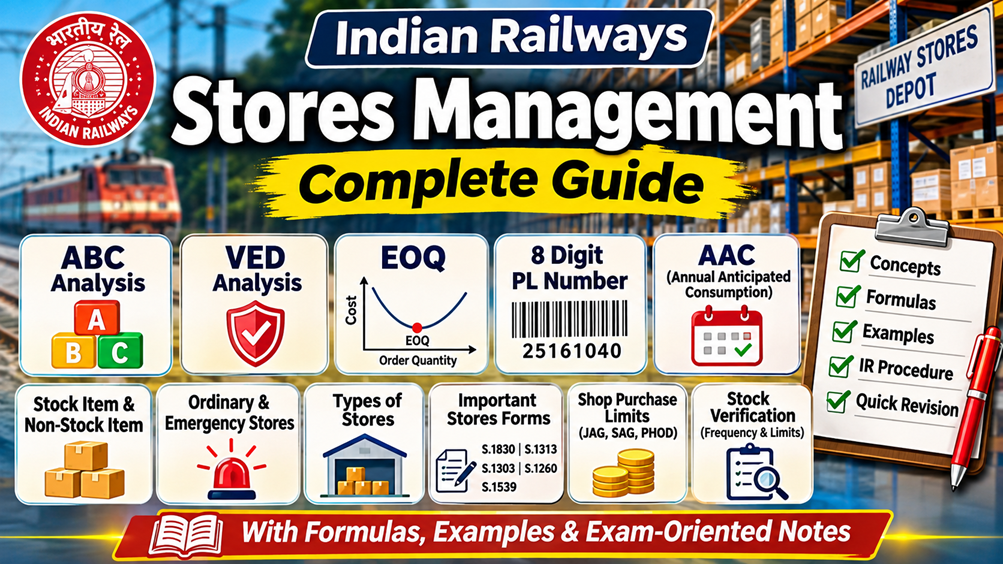
Stores Management is one of the most important functions of Indian Railways. Every railway department requires materials for the maintenance of rolling stock, track, signalling equipment, electrical installations, workshops and other railway infrastructure.
The main objective of Stores Management is to ensure that the right material is available in the right quantity, at the right time, at the right place and at a reasonable cost.
Video Link : https://www.youtube.com/watch?v=TCJPysqxyEI
Effective stores management helps Indian Railways to:
Avoid shortages of essential materials.
Maintain uninterrupted railway operations.
Reduce unnecessary inventory.
Prevent overstocking and wastage.
Maintain proper material accounting.
Ensure timely procurement and issue of stores.
In this article, we will understand Indian Railways Stores Management step by step, starting from basic concepts and progressing to advanced inventory-control techniques.
1. Classification of Stores in Indian Railways
Before understanding inventory control, it is important to understand the different categories of stores.
1.1 Stock Items
Stock items are materials that are regularly required and are authorised to be maintained as inventory in railway stores depots.
These items are replenished when their stock reaches the prescribed level.
Examples may include regularly required maintenance materials, consumables and standard components.
1.2 Non-Stock Items
Non-stock items are materials that are not normally maintained as regular depot inventory.
They are generally purchased against a specific requirement or demand.
1.3 Ordinary Stores
Ordinary stores are materials that are regularly consumed or required for routine railway operations and maintenance.
They are generally maintained in stock to meet recurring requirements.
1.4 Emergency Stores
Emergency stores are materials kept to meet unforeseen requirements or emergencies.
Such materials may not be required frequently, but their immediate availability can be important for railway operations.
1.5 Special Stores
Special stores are materials required for specific works, projects or special purposes.
They are generally arranged against a particular requirement.
1.6 Imprest Stores
Imprest stores are small working balances of materials maintained by authorised departmental officials for day-to-day maintenance requirements.
When materials are consumed, the imprest balance is replenished through the prescribed procedure.
Important: S-1830 is referred to in railway training material for recoupment of imprest stores. Always check the applicable current procedure.
2. Annual Anticipated Consumption (AAC)
AAC stands for Annual Anticipated Consumption.
It means the estimated quantity of a particular material expected to be consumed during the coming year.
AAC is important because it helps the Stores Department plan future procurement and maintain appropriate stock levels.
How is AAC estimated?
AAC may be estimated by considering:
Previous years' consumption.
Current stock position.
Future maintenance requirements.
Changes in operational requirements.
New projects or additional equipment.
Any abnormal or one-time consumption.
A simple planning approach is:
Indicative AAC = Normalised past consumption ± Adjustments for expected changes
Example
Suppose the normalised annual consumption of an item is 1,200 units.
A planned maintenance change is expected to increase consumption by 10%.
AAC = 1,200 + 10% of 1,200
AAC = 1,200 + 120
AAC = 1,320 units
Thus, the anticipated annual consumption is 1,320 units.
3. What is a PL Number in Indian Railways? 
PL stands for Price List Number.
A PL Number is used to identify a particular material in the railway stores system.
It helps in:
Identification of materials.
Standardisation of material descriptions.
Procurement and accounting.
Avoiding confusion between similar items.
Maintaining material records.
Indian Railways uses an eight-digit PL numbering system for material identification.
The coding structure is described as semi-significant, meaning that certain digits convey classification information while other digits distinguish individual items.
Example of an Eight-Digit PL Number
25161040
The exact meaning of each digit or group should be checked against the applicable PL catalogue and coding instructions.
Check Digit Calculation – Illustrative Example
Suppose the first seven digits are:
2 5 1 6 1 0 4
The weighting sequence used in the supplied learning example is:
8 7 6 5 4 3 2
Calculation:
2 × 8 = 16
5 × 7 = 35
1 × 6 = 6
6 × 5 = 30
1 × 4 = 4
0 × 3 = 0
4 × 2 = 8
Total = 16 + 35 + 6 + 30 + 4 + 0 + 8
Total = 99
99 ÷ 11 gives a remainder of 0.
Therefore, in this illustrative example, the check digit is 0.
The resulting number is:
25161040
This example explains the arithmetic provided in the learning notes. The prescribed check-digit algorithm should always be confirmed from the applicable PL coding instructions before operational use.
4. Inventory Control Techniques in Indian Railways
Inventory control is the process of maintaining the appropriate quantity of materials so that shortages and unnecessary stock accumulation can be avoided.
Several techniques are used to analyse and control inventory.
The important techniques are:
ABC Analysis
VED Analysis
FSN Analysis
HML Analysis
SDE Analysis
XYZ Analysis
4.1 ABC Analysis
ABC Analysis is an inventory-control technique based on the annual consumption value of materials.
The annual consumption value is calculated as:
Annual Consumption Value = Annual Quantity Consumed × Unit Price
Materials are divided into three categories:
A Category:
High annual consumption value.
Usually a smaller proportion of total items.
Requires strict monitoring and management attention.
B Category:
Medium annual consumption value.
Requires normal periodic control.
C Category:
Low annual consumption value.
Usually represents a large proportion of total items.
Simpler control procedures may be sufficient.
A commonly used illustrative distribution is:
A Category: 10% of items account for 70% of value.
B Category: 20% of items account for 20% of value.
C Category: 70% of items account for 10% of value.
These percentages are only a teaching illustration. Actual classifications depend on the organisation's consumption data and applicable instructions.
4.2 VED Analysis
VED Analysis is based on the criticality or importance of materials.
VED stands for:
V – Vital
Materials whose non-availability may seriously affect safety or essential railway operations.
E – Essential
Materials whose non-availability may cause operational difficulties, although temporary alternatives may be possible.
D – Desirable
Materials whose short-term non-availability has comparatively limited consequences.
Difference between ABC and VED:
ABC is based on annual consumption value, whereas VED is based on the criticality of an item.
4.3 FSN Analysis
FSN stands for:
F – Fast Moving
S – Slow Moving
N – Non-Moving
This analysis is based on the movement or issue history of materials.
It helps identify regularly consumed items, slowly moving items and materials that have not moved for a considerable period.
4.4 HML Analysis
HML stands for:
H – High Price
M – Medium Price
L – Low Price
It classifies materials according to their unit price.
4.5 SDE Analysis
SDE stands for:
S – Scarce
D – Difficult to Procure
E – Easy to Procure
It classifies materials according to their availability and procurement difficulty.
4.6 XYZ Analysis
XYZ Analysis is commonly used to classify inventory according to the value of stock held at a particular point in time.
The exact classification method and thresholds should be checked against the applicable inventory-control procedure.
5. Economic Order Quantity (EOQ)
EOQ stands for Economic Order Quantity.
It is the order quantity at which the combined ordering and inventory holding costs are minimised under the assumptions of the EOQ model.
In simple words:
EOQ helps determine how much material should be ordered at one time.
EOQ Formula
EOQ = √(2DS / H)
Where:
D = Annual demand in units.
S = Ordering cost per order.
H = Annual holding cost per unit per year.
Example of EOQ Calculation
Suppose:
Annual demand (D) = 2,400 units
Ordering cost (S) = ₹500 per order
Annual holding cost (H) = ₹20 per unit
Applying the formula:
EOQ = √(2 × 2,400 × 500 / 20)
EOQ = √(2,400,000 / 20)
EOQ = √120,000
EOQ ≈ 346 units
Therefore, the economic order quantity is approximately 346 units.
In actual procurement, the quantity may need adjustment for pack sizes, supplier conditions, budget availability, minimum order quantities and applicable railway rules.
6. Re-Order Level, Minimum Level and Maximum Level
EOQ tells us how much to order.
Re-order level tells us when to place an order.
These are two different inventory-control concepts.
Re-Order Level
The re-order level is the stock level at which a fresh order or replenishment action should be initiated.
A basic approach is:
Re-Order Level = Demand During Lead Time + Safety Stock
A traditional textbook-style expression is:
Re-Order Level = Maximum Consumption × Maximum Lead Time
The applicable formula should be checked against the relevant railway procedure.
Minimum Stock Level
Minimum stock level is the lower stock limit intended to prevent shortages.
A commonly used textbook-style expression is:
Minimum Level = Re-Order Level − (Normal Consumption × Normal Lead Time)
Maximum Stock Level
Maximum stock level is the upper stock limit intended to prevent unnecessary accumulation of inventory.
A commonly used textbook-style expression is:
Maximum Level = Re-Order Level + Re-Order Quantity − (Minimum Consumption × Minimum Lead Time)
These expressions are common inventory-management formulas. Apply them only where they match the governing railway instructions and the definitions used in the relevant system.
7. Procurement and Shop Purchase in Indian Railways
Procurement means the process of arranging materials required by railway departments.
Before purchasing any material, the following points should be considered:
Whether the material is a stock item or non-stock item.
Whether the material is available in the stores depot.
Whether an approved source or rate contract is available.
Whether the requirement is urgent.
Whether sufficient budget is available.
Whether the proposed purchase is within the delegated financial powers.
JAG, SAG and PHOD
These are important administrative designations in Indian Railways:
JAG – Junior Administrative Grade
SAG – Senior Administrative Grade
PHOD – Principal Head of Department
Their delegated shop-purchase financial powers must be checked from the latest applicable Railway Board instructions and the concerned Zonal Railway's Schedule of Powers.
Important: Do not rely on old or generalised rupee limits. Financial powers may change and may depend on the nature of purchase, procurement method and applicable conditions.
8. Important Stores Forms in Indian Railways
Stores forms are used to maintain proper documentation of requisition, issue, receipt, return and accounting of materials.
Some important form references are:
S.1302 – Separate Requisition Form
The Indian Railways Stores Code, Volume II, Chapter XIII refers to S.1302 as a separate requisition form.
S.1313 – Combined Requisition and Issue Note
S.1313 is referred to as the Combined Requisition and Issue Note.
It combines the requisition and issue documentation.
S.1830 – Recoupment of Imprest Stores
S.1830 is identified in railway training material for recoupment of imprest stores.
S.1539 – Advice Note of Returned Stores
S.1539 is the Advice Note of Returned Stores.
It is used in the prescribed process for returning materials to stores.
ST-47 – Transfer Challan
ST-47 is a transfer challan reference found in railway training material. Confirm the current local usage.
Important clarification about S-1260 and S-1303
The reference to paragraph 1260 in the Stores Code index concerns Departmental Stock Verification Sheets. This does not establish that S-1260 is a standard form.
Similarly, S-1303 has not been confirmed as a standard form in the official references reviewed here.
Therefore, verify these two references from the current railway form catalogue or local instructions before using them in an examination note or official procedure.
9. Returned Stores in Indian Railways
Sometimes materials issued to a department or workshop are no longer required.
Such materials may be returned to the stores depot through the prescribed procedure.
The return process helps ensure that:
The returned material is properly identified.
Its quantity and condition are recorded.
Serviceable and unserviceable materials are dealt with appropriately.
The stock records are updated.
Reusable material is not unnecessarily purchased again.
S.1539 is identified in the Stores Code material as the Advice Note of Returned Stores.
10. Stock Verification in Indian Railways
Stock verification is the process of physically checking the materials available in a stores depot and comparing the physical quantity with the book balance.
The main objectives are:
To verify the accuracy of stock records.
To identify shortages and excesses.
To detect obsolete or deteriorated materials.
To prevent loss and misuse of railway stores.
To ensure proper accountability.
Steps in Stock Verification
Obtain the relevant stock records.
Identify the location and description of the material.
Physically count or measure the stock.
Compare physical quantity with book balance.
Record discrepancies.
Investigate shortages and excesses.
Submit the verification report and take action under the prescribed rules.
11. Frequency of Stock Verification
The older Stores Code text contains periodicity guidance for different categories of stores.
Commonly cited periodicities include:
| Category | Periodicity in the older text |
|---|---|
| Materials-at-site works | Once a year |
| Stores with imprest holders | Once in two years |
| Tools and Plant | Once in three years |
| A category | Once in six months |
| B category | Once a year |
| C category | Once in two years |
| D category (no issue for 12 months and over) | Once a year |
| Miscellaneous stores with inspectors | Once in three years |
| Machinery and Plant | Once in three years |
Important note: The monetary thresholds historically used for A, B and C categories should not be treated as current universal limits. Different railway instructions and revised systems may prescribe different values or methods. Always refer to the latest Railway Board and Zonal Railway instructions.
12. Movable Surplus and Dead Surplus Stores
Surplus stores are materials that are in excess of likely requirements.
The Stores Code discusses different categories of surplus stores.
Movable Surplus: Materials that are surplus to the requirements of one unit or railway but may still be useful elsewhere.
Dead Surplus: Materials that are unlikely to be required in the foreseeable future and are treated as dead surplus under the applicable rules.
The declaration and disposal of surplus stores must follow the prescribed procedure.
13. Important Formulas for Railway Stores Management
For quick revision, the important formulas are summarised below.
1. Annual Consumption Value
Annual Consumption Value = Annual Quantity Consumed × Unit Price
2. Economic Order Quantity
EOQ = √(2DS / H)
3. Basic Re-Order Point
Re-Order Point = Demand During Lead Time + Safety Stock
4. Traditional Re-Order Level Expression
Re-Order Level = Maximum Consumption × Maximum Lead Time
5. Minimum Stock Level
Minimum Level = Re-Order Level − (Normal Consumption × Normal Lead Time)
6. Maximum Stock Level
Maximum Level = Re-Order Level + Re-Order Quantity − (Minimum Consumption × Minimum Lead Time)
Remember that these formulas are common inventory-management expressions. Use the formula specifically prescribed in the applicable railway manual or procedure wherever it differs.
14. Important One-Liners for Departmental Examinations
AAC stands for Annual Anticipated Consumption.
PL stands for Price List Number.
ABC Analysis is based on annual consumption value.
VED Analysis is based on criticality.
FSN Analysis is based on movement of materials.
HML Analysis is based on unit price.
SDE Analysis is based on procurement difficulty.
EOQ stands for Economic Order Quantity.
EOQ determines how much to order.
Re-order level determines when to order.
S.1313 is the Combined Requisition and Issue Note.
S.1302 is a Separate Requisition Form.
S.1830 is associated with recoupment of imprest stores in railway training material.
S.1539 is the Advice Note of Returned Stores.
JAG stands for Junior Administrative Grade.
SAG stands for Senior Administrative Grade.
PHOD stands for Principal Head of Department.
15. Frequently Asked Questions (FAQs)
Q1. What is ABC Analysis in Indian Railways?
ABC Analysis is an inventory-control technique that classifies materials according to their annual consumption value.
Q2. What is VED Analysis?
VED Analysis classifies materials according to their criticality: Vital, Essential and Desirable.
Q3. What is EOQ?
EOQ means Economic Order Quantity. It calculates an economical order quantity by balancing ordering costs and holding costs.
Q4. What is AAC?
AAC means Annual Anticipated Consumption. It is the estimated annual consumption of a material for the coming year.
Q5. What is a PL Number?
PL Number means Price List Number. It is used to identify materials in the railway stores system.
Q6. What is the difference between stock and non-stock items?
Stock items are authorised to be maintained as regular inventory, whereas non-stock items are generally arranged against specific requirements.
Q7. What is S.1313?
S.1313 is the Combined Requisition and Issue Note.
Q8. What is S.1539?
S.1539 is the Advice Note of Returned Stores.
Q9. What is the difference between EOQ and Re-order Level?
EOQ determines the quantity to be ordered, while the re-order level determines the stock position at which replenishment should be initiated.
Conclusion
Indian Railways Stores Management is a systematic process involving material classification, consumption forecasting, identification, inventory control, procurement, documentation and stock verification.
For effective learning, first understand the basic classification of stores and AAC. Then study PL numbers and inventory-control techniques such as ABC, VED and FSN. After that, learn EOQ, stock levels, procurement procedures, important stores forms and stock verification.
Understanding these topics in sequence will help railway employees, trainees and departmental examination candidates develop a strong foundation in Stores Management.
Study smart, understand the concepts and always refer to the latest Indian Railways Stores Code, Railway Board instructions and Zonal Railway circulars for official application.
References for Further Study
Indian Railways Stores Code, Volume II, Chapter XIII – Requisition and Issue Procedures.
Indian Railways Stores Code, Volume II, Chapter XV – Returned Stores.
Indian Railways Stores Code, Volume II, Chapter XXXII – Stock Verification.
Current Railway Board instructions and Zonal Railway Schedule of Powers.
Official reference links:
Stores Code Chapter XIII: https://rb.indianrailways.gov.in/uploads/codesmanual/StoreDept-II/StoreDeptII_Ch13_data.htm
Stores Code Index: https://rb.indianrailways.gov.in/uploads/codesmanual/StoreDept-II/StoreDeptII_index.htm
Stores Code Chapter XV: https://rb.indianrailways.gov.in/uploads/codesmanual/StoreDept-II/StoreDeptII_Ch15_data.htm
Stores Code Chapter XXXII: https://rb.indianrailways.gov.in/uploads/codesmanual/StoreDept-II/StoreDeptII_Ch32_data.htm