High Density Network (HDN) Routes
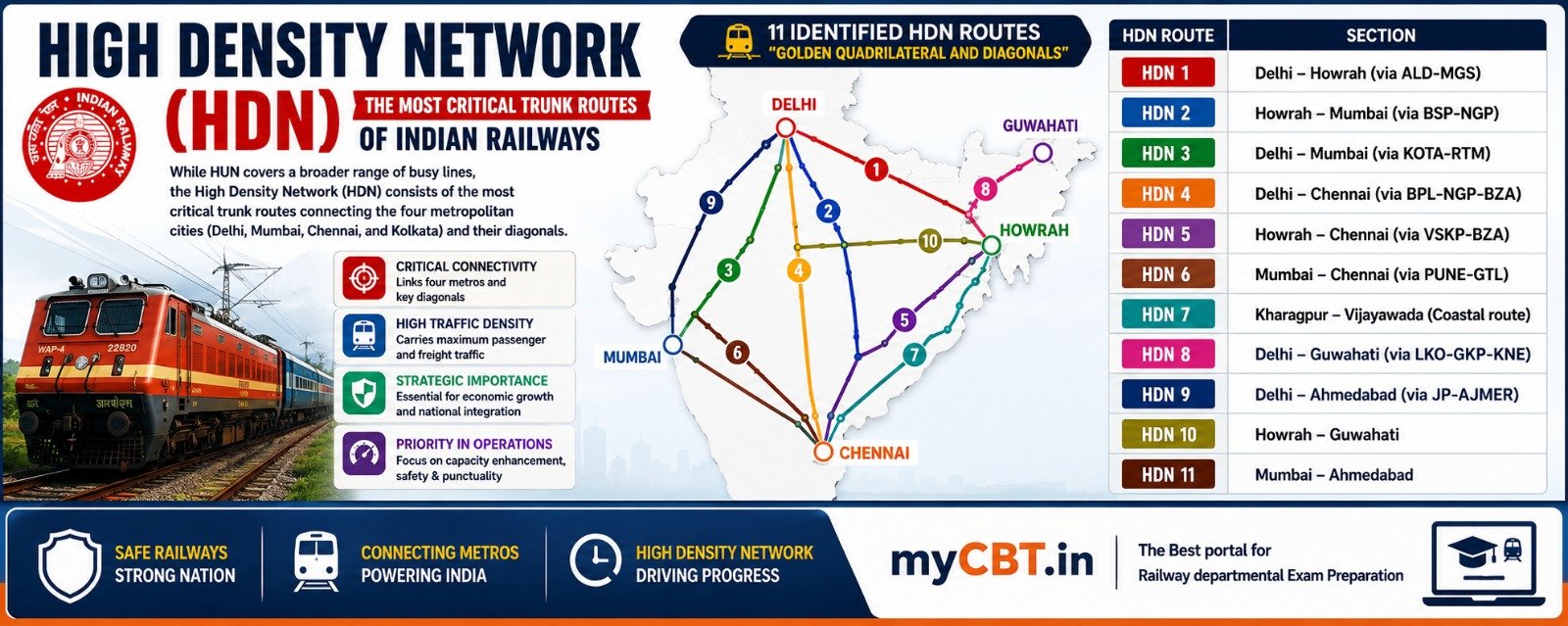
Indian Railways has identified 11 HDN routes.
Total HDN Length: Approximately 11,000 km.
Significance: These routes carry nearly 60% of the total freight traffic and 50% of passenger traffic despite being only about 16% of the total network.
🏗️ The Network Breakdown
The identification is part of the National Rail Plan (NRP) and Mission 3000MT.
1. HDN (High Density Network) - 11 Routes 2. HUN (Highly Utilized Network) - 23 Routes
Apart from HDN, IR identified 23 HUN routes that are reaching 100% capacity. Together, HDN and HUN comprise the core arterial network of IR.
🎯 Exam-Oriented Facts for AOMs
Capacity Utilization: On most HDN routes, utilization is over 120%.
Priority Projects: Automatic Block Signaling (ABS) and Kavach (TCAS) are being implemented on HDN 1 (Delhi-Howrah) and HDN 2 (Delhi-Mumbai) on priority to increase throughput.
Speed Upgrading: Mission Raftar aims to raise speeds on HDN routes to 130 kmph and eventually 160 kmph.
DFCs: The Dedicated Freight Corridors (East & West) are built parallel to HDN 1 and HDN 2 to segregate freight and passenger traffic.
💡 Pro-Tip: If the question asks about the "Golden Quadrilateral and Diagonals", the answer is usually 6 routes (4 sides + 2 diagonals). But for HDN, specifically stick to the number 11.
Highly Utilized Network (HUN)
A total of 109 Highly Utilized Network (HUN) routes have been identified. These routes typically have a capacity utilization of over 100%. The NRP focuses on these sections for technological upgrades (like automatic signaling and 2x25 kV electrification) to increase throughput and speed.
High Density Network (HDN)
While HUN covers a broader range of busy lines, the High Density Network (HDN) consists of the most critical trunk routes connecting the four metropolitan cities (Delhi, Mumbai, Chennai, and Kolkata) and their diagonals.
There are 11 identified HDN Routes (often referred to as the "Golden Quadrilateral and Diagonals"):
Strategic Importance for AOM Exam:
Capacity Utilization: HDN and HUN routes are the primary focus for PH-16 (Traffic Facilities) works, such as doubling, tripling, and yard remodeling, to reduce bottlenecks.
Speed Upgrading: These routes are being upgraded to handle speeds of 130 kmph and eventually 160 kmph (specifically on the Delhi-Mumbai and Delhi-Howrah routes).
Safety: Systems like Kavach (TCAS) are being prioritized for implementation on the HDN and HUN sections first.
Revenue: Although these routes form only about 16% of the total network, they carry nearly 60% of the total freight and 50% of the total passenger traffic.