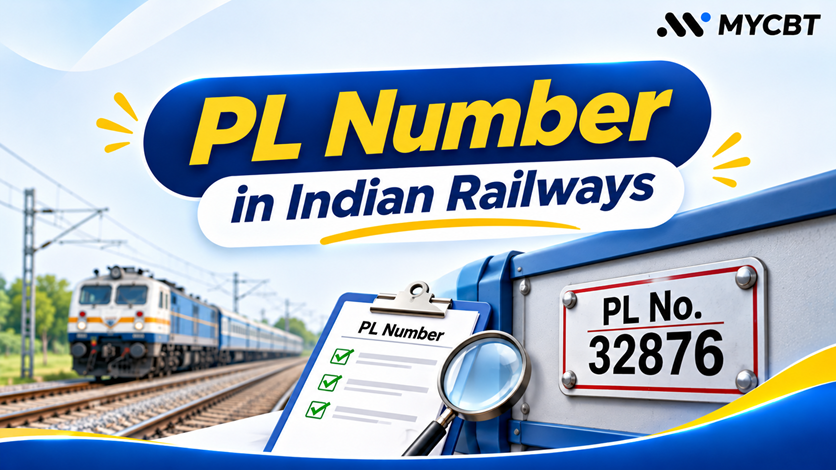
PL Number is an important topic for Indian Railway departmental examinations, LDCE, promotion exams and railway stores-related competitive examinations.
In Railway Stores and material management, the PL Number is used to identify materials distinctly. Understanding the 8-digit PL Number structure, types of codification and Modulus 11 check digit calculation is important for exam preparation.
What is PL Number?
PL Number stands for Price List Number.
Object of PL Number
The main objective of the PL Number is:
To recognize the material distinctly.
It provides a distinct identification number for railway materials.
Applicability
The PL Number system is applicable to:
All Stock Items
It is not applicable to Non-Stock Items, as stated in the source material.
Unified PL
The PL system is Unified PL, meaning it is common for:
All Zonal Railways
Production Units
Types of Codification
There are three types of codification:
Fully Significant
Semi-Significant
Non-Significant
Understanding the difference between these three types is an important examination point.
1. Fully Significant Codification
In a Fully Significant coding system:
All digits signify some property of the material.
Therefore, every digit or part of the code conveys information about some characteristic or property of the material.
Limitation
To adopt a fully significant system, a large number of digits may be required.
As a result, the number of digits may become difficult to manage.
Exam Point
Fully Significant → Every digit has significance.
2. Semi-Significant Codification
In a Semi-Significant coding system:
The first group signifies the property of the material.
The second group has no significance.
According to the provided material:
Indian Railways follows the Semi-Significant system.
The Indian Railway PL Number consists of 8 digits.
Exam Point
Indian Railways → Semi-Significant Codification
PL Number → 8 Digits
3. Non-Significant Codification
In a Non-Significant coding system:
All digits have no significance.
The digits do not indicate any particular property or characteristic of the material.
Quick Comparison
| Type of Codification | Meaning |
|---|---|
| Fully Significant | All digits signify some property of material |
| Semi-Significant | First group is significant; second group has no significance |
| Non-Significant | All digits have no significance |
8-Digit PL Number Structure
Indian Railways follows the Semi-Significant coding system with an 8-digit PL Number.
The eight digits can be represented as:
1 – 2 – 3 – 4 – 5 – 6 – 7 – 8
The PL Number structure is divided into different parts/groups:
Part A
Part B
Part C
Part D
The groups include:
Main Group
Sub Group
Serial Number
Check Digit
The significance is broadly represented as:
Part A + Part B + Part C + Part D
and within the 8-digit structure:
Main Group + Sub Group + Serial Number + Check Digit
The final digit is the Check Digit, which is used for checking the correctness of the PL Number.
Example of an 8-Digit PL Number
Consider the PL Number:
25161040
Its eight digits are:
2 | 5 | 1 | 6 | 1 | 0 | 4 | 0
Here, the last digit (0) is the check digit.
The first seven digits are:
2516104
The check digit is calculated using the Modulus 11 method.
Modulus 11 Method for PL Number
The Modulus 11 method is used to find the check digit of the PL Number.
Let us calculate the check digit for:
PL Number: 25161040
Step 1: Take the First Seven Digits
For calculating the check digit, take the first seven digits of the PL Number.
PL Number = 2516104 + Check Digit
Therefore, the first seven digits are:
2 5 1 6 1 0 4
Step 2: Write Numbers 2 to 8 from Right to Left
Write the numbers 2 to 8 below the seven digits, starting from the right side.
The arrangement is:
| PL Digit | 2 | 5 | 1 | 6 | 1 | 0 | 4 |
|---|---|---|---|---|---|---|---|
| Multiplier | 2 | 3 | 4 | 5 | 6 | 7 | 8 |
Therefore, from right to left, the multipliers are:
8 – 7 – 6 – 5 – 4 – 3 – 2
Step 3: Multiply Vertically
Multiply each digit by its corresponding multiplier:
2 × 8 = 16
5 × 7 = 35
1 × 6 = 6
6 × 5 = 30
1 × 4 = 4
0 × 3 = 0
4 × 2 = 8
Therefore:
16 + 35 + 6 + 30 + 4 + 0 + 8
Step 4: Add the Products
Adding all the products:
16 + 35 + 6 + 30 + 4 + 0 + 8 = 99
So, the total is:
99
Step 5: Divide the Sum by 11
Now divide the total by 11:
99 ÷ 11
The division gives an exact result, so the remainder is 0.
Therefore:
Remainder = 0
Step 6: Determine the Check Digit
The remainder is taken as the check digit.
Therefore:
Check Digit = 0
Hence, the complete PL Number is:
25161040
Important Rule About the Check Digit
According to the provided material:
If the remainder is two digits, the rightmost digit is taken as the Check Digit.
Therefore, the check digit is obtained from the remainder according to this rule.
Example
For the above calculation:
99 ÷ 11 → Remainder = 0
Therefore:
Check Digit = 0
How Does the Check Digit Help?
The check digit helps the computer verify whether the entered PL Number is correct.
For example, if the correct PL Number is:
25161040
and the last digit 0 is correct, the computer will accept the number.
If the check digit is incorrect, the number may be rejected by the system.
Thus, the check digit provides an additional method of checking the correctness of the PL Number.
Modulus 11 and PF Number
The provided material also states that the Modulus 11 method is adopted to check the digit of the PF Number (Provident Fund Number).
Therefore, for examination purposes, remember:
Modulus 11 → PL Number Check Digit
Modulus 11 → PF Number Check Digit
PL Number – Quick Revision
| Point | Important Fact |
|---|---|
| PL stands for | Price List |
| Objective | Distinct recognition of material |
| Applicable to | All Stock Items |
| Not applicable to | Non-Stock Items |
| PL system | Unified PL |
| Common for | All Zonal Railways & Production Units |
| Types of Codification | 3 |
| Type 1 | Fully Significant |
| Type 2 | Semi-Significant |
| Type 3 | Non-Significant |
| Indian Railways follows | Semi-Significant |
| PL Number | 8 Digits |
| Check Digit | Last digit |
| Check Digit method | Modulus 11 |
| Example PL Number | 25161040 |
| First 7 digits | 2516104 |
| Product total | 99 |
| Division | 99 ÷ 11 |
| Remainder | 0 |
| Check Digit | 0 |
Fully Significant vs Semi-Significant vs Non-Significant
Fully Significant
Every digit → Represents a property
Semi-Significant
First group → Significant
Second group → Non-significant
Indian Railways → Follows this system
Non-Significant
All digits → No significance
Easy Memory Trick
Remember:
FULL → All Significant
SEMI → First Part Significant
NON → Nothing Significant
Modulus 11 Calculation – One-Line Formula
For the example 25161040:
(2×8) + (5×7) + (1×6) + (6×5) + (1×4) + (0×3) + (4×2)
= 16 + 35 + 6 + 30 + 4 + 0 + 8
= 99
99 ÷ 11 → Remainder 0
Therefore:
Check Digit = 0
And the complete PL Number is:
25161040
Important One-Liners for Railway Departmental Exams
PL stands for Price List Number.
The objective of PL Number is to recognize material distinctly.
PL Number is applicable to Stock Items.
PL Number is not applicable to Non-Stock Items, according to the provided notes.
The PL system is called Unified PL.
Unified PL is common for all Zonal Railways and Production Units.
There are three types of codification.
The three types are Fully Significant, Semi-Significant and Non-Significant.
In Fully Significant codification, all digits signify some property of the material.
Fully Significant coding may require a large number of digits.
In Semi-Significant coding, the first group signifies the property of the material.
In Semi-Significant coding, the second group has no significance.
Indian Railways follows Semi-Significant codification.
The PL Number consists of 8 digits.
In Non-Significant coding, all digits have no significance.
The last digit of the PL Number is the Check Digit.
The check digit is calculated using the Modulus 11 method.
In the example 25161040, the first seven digits are 2516104.
For the calculation, multipliers 2 to 8 are assigned from right to left.
The products in the example are 16, 35, 6, 30, 4, 0 and 8.
The sum of the products is 99.
99 divided by 11 leaves remainder 0.
Therefore, the check digit is 0.
The complete PL Number is 25161040.
If the remainder has two digits, the rightmost digit is taken as the check digit, according to the provided notes.
The Modulus 11 method is also stated in the notes to be used for checking the PF Number.
Frequently Asked Questions
What does PL Number stand for?
PL Number stands for Price List Number.
What is the purpose of PL Number?
Its purpose is to recognize the material distinctly.
Is PL Number applicable to Non-Stock Items?
According to the provided notes, No. It is applicable to Stock Items and not Non-Stock Items.
How many types of codification are there?
There are three types:
Fully Significant
Semi-Significant
Non-Significant
Which codification system is followed by Indian Railways?
Semi-Significant Codification.
How many digits are there in the PL Number?
The PL Number has 8 digits.
Which method is used to calculate the PL Number check digit?
The Modulus 11 method.
What is the check digit in PL Number 25161040?
The check digit is 0.
What is the sum obtained in the Modulus 11 example?
The sum is 99.
What is the remainder when 99 is divided by 11?
The remainder is 0.
Conclusion
The PL Number (Price List Number) is an important identification system used for railway materials. For departmental and LDCE examinations, candidates should remember the purpose of PL Number, applicability, Unified PL, three types of codification, Semi-Significant coding followed by Indian Railways, 8-digit structure and Modulus 11 check-digit calculation.
The most important numerical facts to remember are:
PL Number → 8 Digits
Indian Railways → Semi-Significant Codification
Check Digit → Modulus 11
Example → 25161040
Sum → 99
Remainder → 0
Check Digit → 0
For more Railway departmental exam preparation, revision notes and practice material, visit:
myCBT.in – Best Departmental Exam Preparation Portal