Railway safety and accident management are important topics for Indian Railway departmental exams, LDCE, promotion exams and other railway competitive examinations. This article covers important exam-oriented points on Train Delayed in Block Section, Anti Collision Device (Raksha Kavach), Hooter Codes, Accident Drill, Golden Hour and Disaster Management.
These notes are arranged topic-wise for quick revision and easy recall.
1. Train Delayed in Block Section
Reference: GR-6.04 / SR 6.04-1
A train is considered to be running late when it does not arrive at the station within the specified time after its normal running time from the station in rear.
When is a train considered to be running late?
Passenger Train:
If a passenger train does not arrive within 10 minutes after its normal running time from the station in rear, it is considered to be running late.
Goods Train:
If a goods train does not arrive within 20 minutes after its normal running time from the station in rear, it is considered to be running late.
Action to be taken by the Station Master
When a train is running late in the block section, the Station Master shall immediately take the following action:
The Station Master shall immediately advise the Station Master in rear and the Section Controller about the fact.
The Station Master shall arrange to send a railway employee into the block section to obtain information regarding the whereabouts of the train.
In case of a mishap, information should also be obtained regarding the nature of assistance required.
Exam Point
Remember the important time limits:
Passenger Train → 10 minutes
Goods Train → 20 minutes
2. Anti Collision Device (Raksha Kavach) – ACD
Definition
The Anti Collision Device (ACD) is a network of self-acting, computer-based communication devices that automatically apply brakes to trains.
Its purpose is to protect the travelling public as well as road users at level crossing gates from collision-related accidents.
The system is designed to improve railway safety and reduce the possibility of dangerous train collisions.
Main Components of ACD
The Anti Collision Device comprises important components including:
Central Processing Unit (CPU)
Global Positioning System (GPS)
Receiver
Data Radio Modem for communication with other ACDs
Important Features of ACD
ACD is a fully integrated Electronic Control System designed to minimize collisions and increase safety in the railway system.
It is a non-signalling system and provides additional safety in train operation.
It is intended to prevent dangerous train collisions caused by:
Human reasons
Human limitations
Equipment failure
ACD is a non-signalling and interlocking system in the sense described in the source material; it does not replace the existing signalling and interlocking system.
It does not alter the existing procedures of train operations.
The world's first ACD was taken into use on 19-10-1990 in Konkan Railway.
Quick Revision
ACD = Anti Collision Device
CPU + GPS + Receiver + Data Radio Modem
Purpose = Additional safety + collision prevention
Nature = Non-signalling system
First ACD = 19-10-1990, Konkan Railway
3. Hooter Code and ART / MRV
What is the purpose of the Hooter?
Hooter is used to inform concerned personnel about an accident at stations where an Accident Relief Train (ART) and Medical Relief Van (MRV) are available.
Each hooter will blow for 45 seconds.
The time interval between the hooter codes is kept at 5 seconds for clear understanding.
Hooter Code – Important Meanings
| Hooter Code | Meaning |
|---|---|
| Two Hooters | ART / Road Mobile ART required at the home station |
| Three Hooters | ART / Road Mobile ART required outside the home station |
| Four Hooters | ART / Road Mobile ART and MRV required at the home station |
| Five Hooters | ART / Road Mobile ART and MRV required outside the home station |
| One Long Hooter – 90 seconds | Cancellation of medical van and breakdown train |
Important Numbers to Remember
Each Hooter = 45 seconds
Interval between hooter codes = 5 seconds
One Long Hooter = 90 seconds
Easy Memory Trick
2 → ART at Home
3 → ART Outside
4 → ART + MRV at Home
5 → ART + MRV Outside
4. Accident Drill – Intention of Mock Drill
Reference: AM-406-6
An accident drill or mock drill is conducted to check preparedness, practical knowledge and the effectiveness of emergency arrangements.
Main Objectives of Accident / Mock Drill
The important intentions of a mock drill are:
To test the practical knowledge of the staff concerned.
To provide practice because practice leads to perfection.
To find out the alertness of staff.
To measure the results of training and drills.
To check the equipment.
The drill is not limited only to relief train staff. It also involves:
Control staff
Guards
Station Masters
Supervisors
PWI
SI
LI
TI
CWI
Officers
Exam Focus
The main idea behind an accident mock drill is:
Practice + Alertness + Training Assessment + Equipment Check
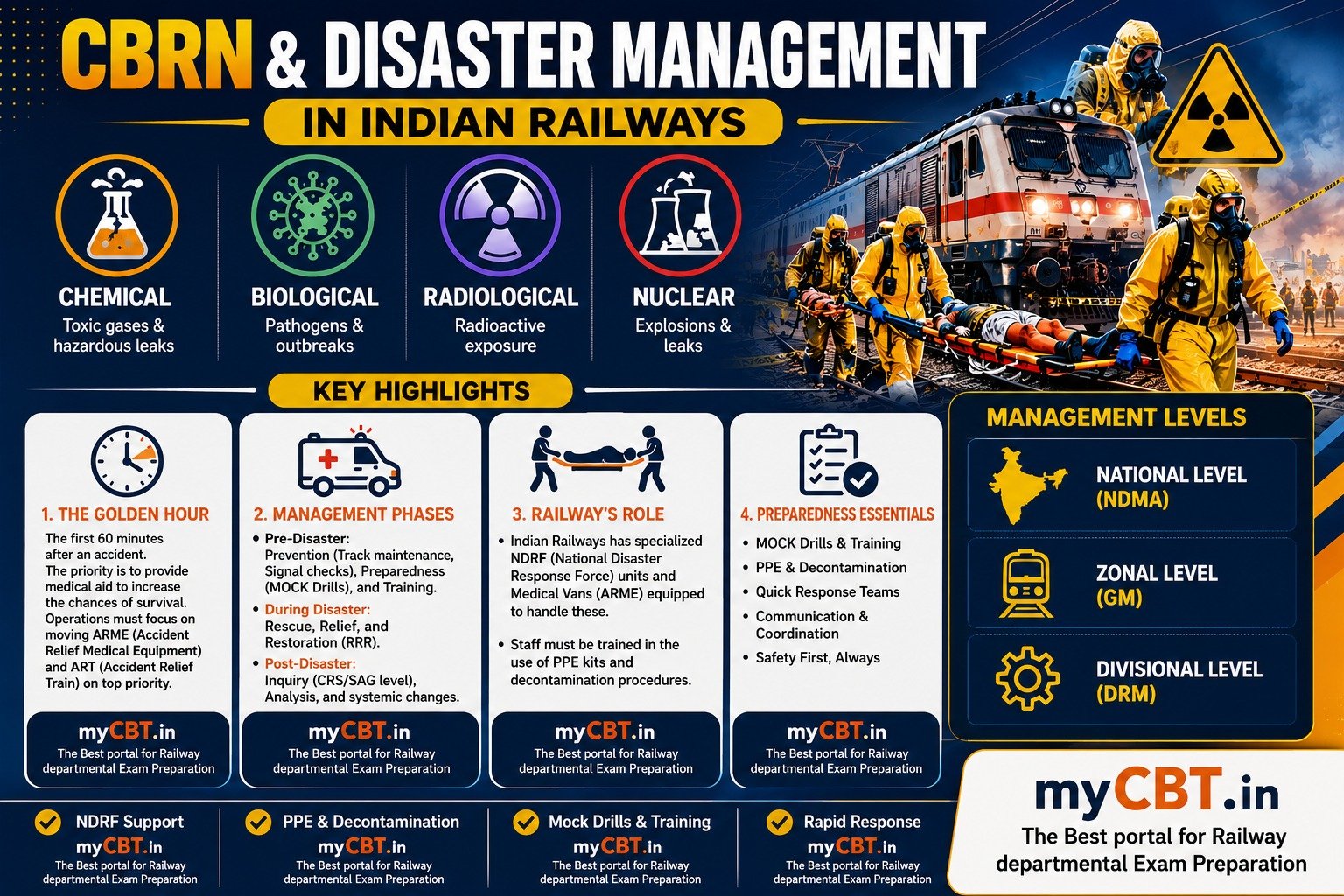
5. Golden Hour in Railway Accidents
What is the Golden Hour?
The Golden Hour refers to the first hour following an accident.
During an accident, many affected patients may die due to traumatic shock and the physiological changes associated with immobility and related conditions.
The first hour is therefore considered extremely important because many trauma patients can be saved when bleeding is effectively controlled and blood pressure is restored within one hour.
Important Point
Golden Hour = First one hour after an accident
During this period, timely medical attention, control of bleeding and restoration of blood pressure are important for saving lives.
6. Disaster Management in Railways
Meaning of Disaster Management
The preparations made by the railway administration to manage any possible accident are referred to as Disaster Management / Accident Management.
The main objective of railway administration is to provide passengers with a safe and accident-free railway journey.
Continuous efforts are made to improve railway safety. Modern technologies are incorporated into railway operations to reduce dependence on human intervention.
Arrangements are also made to minimize the possibility of incorrect actions caused by employee mistakes.
Employees are provided with high-quality training, including training to remain calm and stress-free during difficult situations.
Even with these preventive measures, the possibility of an accident cannot be completely eliminated. Therefore, railway administration maintains advance arrangements for quick management of such situations.
Important Disaster Management Arrangements
1. Accident Relief and Medical Vehicles
For railway safety and emergency management, arrangements should be available for an accident relief vehicle and medical vehicle at a distance of 150 to 200 km.
These vehicles should be readily available during an emergency so that assistance can be provided without unnecessary delay.
2. 24-Hour Staff Availability
Under the system, 24-hour staff availability is required.
Trained staff should be available at any time, day or night, to take immediate action during an emergency.
It is also important to ensure that the rescue vehicle and medical vehicle can be dispatched within the stipulated time.
3. First-Aid Training
Every employee involved in railway operations should be trained in first aid.
Such training enables employees to provide necessary immediate assistance to injured persons during an emergency.
4. First-Aid Box
The Station Master and Guard should have a first-aid box so that immediate first aid can be provided when required.
5. Emergency Contact Information
The Station Master's office should have readily available information including:
Telephone numbers of important local administrative officials
Telephone numbers of police officials
Names of hospitals
Hospital contact numbers
This information helps in providing immediate information and arranging assistance during an emergency.
7. Objectives of Accident Management
The major objectives of accident management are as follows:
1. Protect the Side Line
The side line should be protected so that another accident does not occur.
2. Protect the Accident Site
The accident site should be protected and properly managed.
3. Save Lives and Provide Medical Assistance
The primary objective is to save lives and provide:
First aid
Medical aid
Necessary emergency assistance
This helps save injured persons and reduce their suffering.
4. Protect Railway and Public Property
Proper management and surveillance should be arranged for the security of:
Railway property
Public property
Post
This helps prevent theft, loss and other criminal activities.
5. Comfort and Assist Passengers
Passengers at the accident site should be comforted and assisted.
Trained staff should be present to understand the physical and mental condition of passengers and provide necessary assistance.
Apart from first aid, psychological support and other necessary services may also be provided so that passengers feel safe and relieved.
6. Arrange Transportation for Stranded Passengers
Transportation should be arranged quickly for passengers trapped or stranded due to an accident.
Depending on the situation, transportation may include:
Buses
Ambulances
Other suitable transport facilities
The objective is to move passengers safely and conveniently to a safe place or their destination.
7. Preserve Evidence and Find the Cause
All evidence and clues related to the accident should be preserved so that the investigation is not affected.
An expert team should investigate the causes of the accident.
Such investigation helps in:
Finding the cause of the accident
Preventing similar incidents in the future
Taking necessary corrective measures
8. Restore Railway Traffic
One of the important objectives is to restart railway traffic as soon as possible after the accident and necessary safety arrangements.
Quick Revision Table
| Topic | Important Point |
|---|---|
| Train delayed – Passenger | 10 minutes |
| Train delayed – Goods | 20 minutes |
| Delay action | Advise SM in rear + Section Controller |
| Block section | Send railway employee to obtain train information |
| ACD | Anti Collision Device |
| ACD components | CPU + GPS + Receiver + Data Radio Modem |
| ACD nature | Non-signalling system |
| First ACD | 19-10-1990, Konkan Railway |
| Hooter | Accident information |
| Each hooter | 45 seconds |
| Hooter interval | 5 seconds |
| Two hooters | ART at home station |
| Three hooters | ART outside home station |
| Four hooters | ART + MRV at home station |
| Five hooters | ART + MRV outside home station |
| One long hooter | 90 seconds – cancellation of medical van and breakdown train |
| Mock drill | Practical knowledge, alertness, training & equipment |
| Golden Hour | First one hour after accident |
| ART/MRV arrangement | 150–200 km |
| Staff availability | 24 hours |
| Accident management | Save lives, protect site/property, assist passengers, preserve evidence and restore traffic |
Important One-Liners for Departmental Exam Preparation
A passenger train is considered running late if it does not arrive within 10 minutes after its normal running time from the station in rear.
A goods train is considered running late if it does not arrive within 20 minutes after its normal running time from the station in rear.
In case of a delayed train, the Station Master advises the SM in rear and Section Controller.
A railway employee is sent into the block section to obtain information about the whereabouts of the train and, in case of mishap, the assistance required.
ACD stands for Anti Collision Device.
ACD is a network of self-acting computer-based communication devices.
ACD can automatically apply brakes to trains.
Important ACD components include CPU, GPS, receiver and data radio modem.
ACD is described as a non-signalling system providing additional safety in train operation.
ACD does not replace existing signalling and interlocking systems.
The world's first ACD was taken into use on 19-10-1990 in Konkan Railway.
Hooter is used to communicate information regarding an accident where ART and MRV facilities are available.
Each hooter sounds for 45 seconds.
The interval between hooter codes is 5 seconds.
Two hooters indicate ART/Road Mobile ART at home station.
Three hooters indicate ART/Road Mobile ART outside home station.
Four hooters indicate ART/Road Mobile ART + MRV at home station.
Five hooters indicate ART/Road Mobile ART + MRV outside home station.
One long hooter of 90 seconds indicates cancellation of the medical van and breakdown train.
Accident drills are conducted to test practical knowledge and staff alertness and to check training and equipment.
The Golden Hour refers to the first hour after an accident.
Accident management includes advance preparation for handling possible accidents.
Accident relief and medical vehicles should be arranged at a distance of 150–200 km according to the provided notes.
24-hour staff availability is required for emergency response.
Station Masters and Guards should have first-aid boxes.
Important local administration, police and hospital contact details should be available in the Station Master's office.
Accident management aims to protect the side line and accident site, save lives, protect property, assist passengers, preserve evidence and restore railway traffic as soon as possible.
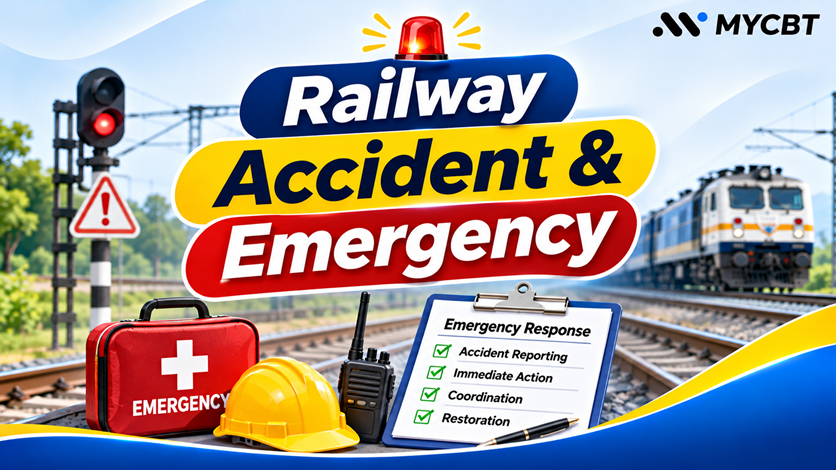
Railway accident and emergency management is an important area for LDCE and departmental examination preparation. The most important facts to remember include the 10-minute and 20-minute train-delay limits, ACD features, Hooter Code meanings, mock-drill objectives, Golden Hour, ART/MRV arrangements and the eight objectives of accident management.
For examination preparation, candidates should focus particularly on numbers, definitions, codes, responsibilities and sequence of actions, as these points are easier to test in objective-type and departmental examinations.
myCBT.in – Best Departmental Exam Preparation Portal
Prepare smarter, revise important railway rules and strengthen your departmental examination preparation with myCBT.in.
Available on Play Store also.