Free Time for Loading and Unloading of Wagons in Indian Railways: Complete Guide, EOL & Non-EOL Rules, Tables and Latest Updates
Last Updated: 17 November 2026
Free time for loading and unloading of wagons is an important concept in Indian Railways' freight operations. It determines the permissible time allowed to railway customers for loading or unloading a rake without attracting demurrage charges.
The permissible free time varies according to several factors, including:
Type of wagon (Open, Covered, Hopper, Flat, Tank, etc.).
Type of terminal (Engine-On-Load or Non-Engine-On-Load).
Method of handling (Manual or Mechanized).
Number of wagons placed.
Type of commodity and special handling requirements.
Indian Railways has issued several amendments and corrigenda to the Rates Master Circular on Demurrage, Wharfage and Waiver, 2016/0 to revise and clarify the permissible free time.
This article explains the free-time rules for different wagon types, EOL and Non-EOL terminals, special commodities, additional allowances, demurrage rules and important Railway Board instructions.
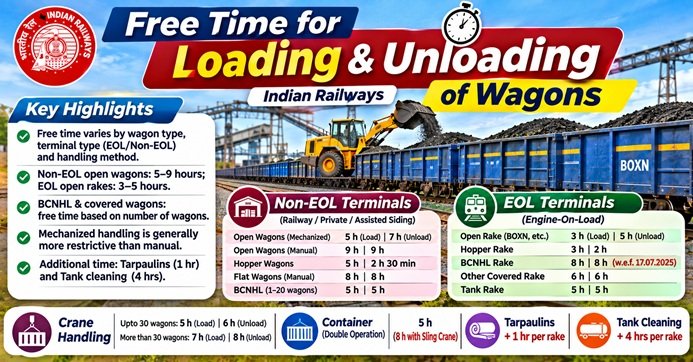
Quick Answer: Free time is the permissible time allowed for loading or unloading railway wagons before demurrage becomes chargeable. For example, at Non-EOL terminals, open wagons generally receive 5 hours for mechanized loading, 7 hours for mechanized unloading and 9 hours for manual loading or unloading. At EOL terminals, open rakes generally receive 3 hours for loading and 5 hours for unloading, subject to applicable exceptions.
1. What is Free Time in Indian Railways?
Free time is the prescribed period allowed for loading or unloading wagons at railway goods sheds, railway sidings, private sidings, freight terminals and other notified locations.
If railway rolling stock is detained beyond the permissible free time, Demurrage Charges may be levied.
The applicable free time is determined by the relevant Railway Board instructions and depends on the wagon type, terminal category and handling method.
What is Demurrage?
Demurrage is the charge levied for detention of railway rolling stock beyond the prescribed free time allowed for loading or unloading.
Important: The entire group of wagons placed for loading or unloading is treated as one unit for the purpose of levy of demurrage. Even if one wagon in the group is detained beyond the permissible free time, demurrage may be levied on all wagons in that group.
2. Types of Terminals: EOL and Non-EOL
Before understanding the free-time tables, it is important to understand the difference between EOL and Non-EOL terminals.
A. Non-EOL Terminal (Non-Engine-On-Load)
These include railway goods sheds, railway sidings, public sidings and private/assisted sidings that do not operate on an Engine-On-Load basis.
The permissible free time generally varies according to:
Wagon type.
Manual or mechanized handling.
Number of wagons.
Type of commodity.
B. EOL Terminal (Engine-On-Load)
EOL stands for Engine-On-Load.
At EOL terminals, the railway locomotive remains available during the loading or unloading operation, subject to the applicable operational arrangement.
The permissible free time is different from that of Non-EOL terminals.
As a general rule, EOL free time is reckoned from the time of placement of the rake, subject to the detailed rules governing placement and release.
3. Free Time at Non-EOL Terminals
The following tables provide the standard permissible free time for different wagon categories at railway terminals and private/assisted sidings other than steel plants, which do not work on an EOL basis.
Table 1: Free Time for Open, Hopper and Flat Wagons
Permissible Free Time (Hours)
| Type of Wagon | Mechanized Loading | Mechanized Unloading | Manual Loading | Manual Unloading |
|---|---|---|---|---|
| Open Wagons (BOXN, BOX, etc.) | 5 | 7 | 9 | 9 |
| Hopper Wagons (BOBR, BOBY, etc.) | 5 | 2.5 | N.A. | N.A. |
| Flat Wagons (BRN, BFK, etc.) | 6 | N.A. | 8 | 8 |
Important Points:
Open wagons have 5 hours for mechanized loading.
Open wagons have 7 hours for mechanized unloading.
Manual loading and unloading of open wagons are allowed 9 hours each.
Mechanized unloading of hopper wagons is allowed 2 hours and 30 minutes.
Manual loading and unloading of flat wagons are allowed 8 hours each.
Table 2: Free Time for Covered Wagons at Non-EOL Terminals
The permissible free time for covered wagons depends on the number of wagons placed.
A. BCNHL Wagons
| Number of Wagons | Loading | Unloading |
|---|---|---|
| 1 to 20 wagons | 5 hours | 5 hours |
| 21 to 30 wagons | 7 hours | 7 hours |
| 31 to 45 wagons | 9 hours | 9 hours |
| 46 wagons and above | 11 hours | 11 hours |
B. Other Covered Wagons (Other than BCNHL)
| Number of Wagons | Loading | Unloading |
|---|---|---|
| 1 to 20 wagons | 5 hours | 5 hours |
| 21 to 30 wagons | 7 hours | 7 hours |
| 31 wagons and above | 9 hours | 9 hours |
Examination Tip: For BCNHL wagons, remember the sequence:
5 – 7 – 9 – 11 hours
For other covered wagons, remember:
5 – 7 – 9 hours
Table 3: Free Time for Tank Wagons at Non-EOL Terminals
Tank wagons have separate free-time provisions depending on the type of oil carried and the number of wagons.
A. Other Than Black Oil
| Number of Wagons | Loading | Unloading |
|---|---|---|
| Up to 29 wagons | 6 hours | 6 hours |
| 30 wagons and above | 6 hours | 8 hours |
B. Black Oil
| Number of Wagons | Loading | Unloading |
|---|---|---|
| Up to 29 wagons | 7 hours | 7 hours |
| 30 wagons and above | 7 hours | 9 hours |
What is Black Oil?
Black Oil includes:
Light Diesel Oil (LDO)
Furnace Oil
Carbon Black Feed Stock
Low Sulphur Heavy Stock
Heavy Petroleum Stock
Vacuum Gas Oil
4. Free Time for Other Special Wagon Categories at Non-EOL Terminals
Apart from open, covered, flat, hopper and tank wagons, separate free-time provisions apply to certain special categories.
Table 4: Special Wagon Categories
| Type | Loading | Unloading | Handling |
|---|---|---|---|
| BCFC Wagons | 13 hours | 16 hours | Mechanized |
| Military Wagons (KM) | 4 hours | 4 hours | Manual |
| Other Military Wagons (DBKM etc.) | 5 hours up to 20 wagons; 7 hours for 21 or more | 5 hours up to 20 wagons; 7 hours for 21 or more | Manual |
| Indo-Nepal Container Traffic | 3 hours | 3 hours | As applicable |
| Livestock | 4 hours | 4 hours | As applicable |
Note: Container free-time provisions in this table relate to Indo-Nepal traffic. Livestock and special military wagon provisions should be read with the relevant Railway Board instructions.
5. Free Time at EOL Terminals (Engine-On-Load)
At EOL terminals, the permissible free time is different from that at Non-EOL terminals.
Table 5: EOL Free Time for Different Types of Wagons
Permissible Free Time (Hours)
| Type of Rake | Loading | Unloading |
|---|---|---|
| Open Rake (BOXN, etc.) – Other than Steel | 3 | 5 |
| Open Rake – Steel | 6 | 5 |
| Hopper Rake (BOBR, etc.) | 3 | 2 |
| Flat Rake (BRN, BFK, etc.) | 6 | 6 |
| Covered Rake – BCNHL | 8 | 8 |
| Other Covered Rake (other than BCNHL) | 6 | 6 |
| Tank Rake (BTPN, etc.) | 5 | 5 |
Important Update: The BCNHL free time at EOL terminals was revised through Corrigendum No. 59 dated 14.07.2025, effective from 17.07.2025.
The revised provision is:
BCNHL Rake: 8 hours for loading.
BCNHL Rake: 8 hours for unloading.
Other Covered Rakes: 6 hours for loading and 6 hours for unloading.
This amendment should be remembered for departmental examinations.
6. Special Free Time for Consignments Handled by Crane
Where a consignment is handled by crane, special free-time provisions apply irrespective of the type of wagon.
Table 6: Free Time for Crane Handling
| Number of Wagons | Loading | Unloading |
|---|---|---|
| Up to 30 wagons | 5 hours | 6 hours |
| More than 30 wagons | 7 hours | 8 hours |
These provisions apply to consignments handled by crane irrespective of the free time otherwise prescribed for different wagon categories.
Important Points
Up to 30 wagons: 5 hours for loading and 6 hours for unloading.
More than 30 wagons: 7 hours for loading and 8 hours for unloading.
These provisions apply irrespective of wagon type when the consignment is handled by crane.
7. Special Free Time for Container Traffic
For container traffic, special rules apply in cases of double operation.
What is Double Operation?
Double operation means unloading followed by loading in the same wagon.
The permissible free time is:
| Type of Operation | Free Time |
|---|---|
| Double operation of container traffic | 5 hours |
| Container commodity handled by sling cranes – Single operation | 6 hours |
| Container commodity handled by sling cranes – Double operation | 8 hours |
Important: Do not confuse the general double-operation allowance of 5 hours with the special sling-crane allowance of 8 hours for double operation.
8. Additional Free Time and Special Allowances
Apart from the normal free time, Indian Railways has provided additional allowances for certain operations.
A. Additional Time for Covering Open Wagons with Tarpaulins
An additional allowance of 1 hour per rake is provided under the applicable instructions for covering open wagons with tarpaulins while loading loose or bulk commodities such as coal and coke.
This provision is relevant to open wagons such as BOXN and similar top-open wagons.
Latest clarification: Railway Board issued a letter dated 10.09.2026 regarding additional free time for uncovering wagons with tarpaulins. The Board clarified that the existing guidelines would continue and no change was envisaged at that time.
Therefore, the September 2026 letter should not be interpreted as introducing a new additional allowance for unloading.
B. Additional Time for Cleaning Tank Wagons Carrying Edible Oil
Additional free time is provided for cleaning, mopping and drying tank wagons used for edible oil when there is a change of product.
The allowance mentioned in the relevant instructions is 4 hours.
Railway Board's Rates Circular No. 02 of 2025, dated 25.02.2025, also addresses the additional free time for cleaning activities in tank wagons in private sidings and goods sheds in the case of edible oil when there is a change of product.
For application, refer to the current validity and conditions of the circular rather than relying only on the historical expiry date of 31.03.2025.
9. Important Operational Rules Regarding Free Time
The following rules are important for both railway operations and examination preparation.
1. Entire Group of Wagons Treated as One Unit
The entire group of wagons placed for loading or unloading is treated as one unit for the purpose of demurrage.
If even one wagon in the group is detained beyond the prescribed free time, demurrage may be levied on all wagons in that group.
2. More Restrictive Free Time Applies
If both manual and mechanized operations are used for loading or unloading a rake, the more restrictive free time, i.e. the free time prescribed for mechanized operation, will apply.
Example:
For open wagons at Non-EOL terminals:
Manual loading: 9 hours.
Mechanized loading: 5 hours.
If both methods are used, the more restrictive allowance of 5 hours applies.
3. Loading by Pay Loader Is Mechanized Loading
Loading by pay loader is treated as mechanized loading.
4. Stationary Wagons Using Mechanized Movable Weight-O-Meter Wagon Loader
Loading of stationary wagons through a mechanized movable weight-o-meter wagon loader is also treated as mechanized loading.
5. Applicability to BG and MG Wagons
The prescribed free time is equally applicable to Broad Gauge (BG) and Metre Gauge (MG) wagons, subject to the relevant provisions.
6. Entire Rake Detention
In the case of multiparty, multi-consignor or multi-consignee rakes, the rake is treated as a unit for free time and demurrage purposes, subject to the provisions governing responsibility for detention.
10. Special Provisions for Coal and Iron Ore Loading
Railway Board has delegated powers to Zonal Railways to reduce permissible free time for mechanized loading of coal and iron ore in certain circumstances.
As per the provisions compiled in the Demurrage and Wharfage Compendium:
Zonal Railways may reduce mechanized loading free time to 3 hours at notified goods sheds or sidings where two or more coal or iron ore rakes are loaded from a single line.
Zonal Railways may also reduce mechanized unloading free time for open rakes of coal or iron ore from 7 hours to 5 hours, subject to the prescribed conditions.
The PCCM, in consultation with PCOM, is responsible for notifying the concerned locations.
A notice period of two weeks is required before implementation.
Necessary updating in CRIS/FOIS is also required.
Important: This is a special delegated provision and should not be confused with the general free-time table applicable to all terminals.
11. Important Railway Board Circulars and Letter Numbers
The following circulars and instructions are particularly relevant for understanding free time for loading and unloading of wagons.
| S. No. | Circular / Letter | Date | Subject |
|---|---|---|---|
| 1 | Rates Master Circular/Demurrage-Wharfage-Waiver/2016/0 | 2016 | Main policy framework |
| 2 | Corrigendum No. 48 | 21.02.2024 | Additional free time for edible oil tank-wagon cleaning |
| 3 | Corrigendum No. 50 | 29.02.2024 | Free time for loading/unloading coal and iron ore – power to Zonal Railways |
| 4 | Corrigendum No. 51 | 29.02.2024 | Free time for loading bagged consignments in open wagons at EOL terminals |
| 5 | Corrigendum No. 54 | 07.11.2024 | Free time for crane-handled consignments at EOL terminals |
| 6 | Corrigendum No. 55 | 31.12.2024 | Free time when hopper wagons are supplied instead of open wagons |
| 7 | Rates Circular No. 02 of 2025 | 25.02.2025 | Additional free time for edible-oil tank cleaning and revision for seven old steel plants |
| 8 | Corrigendum No. 59 | 14.07.2025 | Free time for BCNHL rakes at EOL terminals |
| 9 | Letter No. TC-I/2019/201/6-Part(1) (3327639) | 10.09.2026 | Clarification regarding additional free time for uncovering tarpaulins |
Important Letter Numbers
Corrigendum No. 59 – BCNHL at EOL terminals
Letter No.: TC-I/2024/201/efile/5 (3473922)
Date: 14.07.2025
Effective from: 17.07.2025
Clarification on Tarpaulin Uncovering
Letter No.: TC-I/2019/201/6-Part(1) (3327639)
Date: 10.09.2026
Subject: Additional Free Time for Uncovering Wagons with Tarpaulins.
Demurrage and Wharfage Compendium
Rates Master Circular/Demurrage-Wharfage-Waiver/2016/0
Compendium of Demurrage & Stabling, Wharfage & Stacking, and Waiver/Write-off provisions, updated through 2025, with subsequent Board instructions to be referred to.
12. Quick Revision Table – Free Time for Railway Exams
| Question | Answer |
|---|---|
| What is demurrage? | Charge for detention of railway rolling stock beyond free time |
| Open wagon mechanized loading at Non-EOL | 5 hours |
| Open wagon mechanized unloading at Non-EOL | 7 hours |
| Open wagon manual loading at Non-EOL | 9 hours |
| Open wagon manual unloading at Non-EOL | 9 hours |
| Hopper wagon mechanized loading at Non-EOL | 5 hours |
| Hopper wagon mechanized unloading at Non-EOL | 2 hours 30 minutes |
| Flat wagon manual loading at Non-EOL | 8 hours |
| Flat wagon manual unloading at Non-EOL | 8 hours |
| BCFC mechanized loading | 13 hours |
| BCFC mechanized unloading | 16 hours |
| BCNHL 1–20 wagons at Non-EOL | 5 hours |
| BCNHL 21–30 wagons at Non-EOL | 7 hours |
| BCNHL 31–45 wagons at Non-EOL | 9 hours |
| BCNHL 46 or more wagons at Non-EOL | 11 hours |
| Open rake loading at EOL (others) | 3 hours |
| Open rake unloading at EOL | 5 hours |
| Hopper rake loading at EOL | 3 hours |
| Hopper rake unloading at EOL | 2 hours |
| BCNHL loading at EOL | 8 hours |
| BCNHL unloading at EOL | 8 hours |
| Crane loading up to 30 wagons | 5 hours |
| Crane unloading up to 30 wagons | 6 hours |
| Crane loading above 30 wagons | 7 hours |
| Crane unloading above 30 wagons | 8 hours |
| Container double operation | 5 hours |
| Sling crane container double operation | 8 hours |
| Additional tank cleaning allowance | 4 hours, subject to applicable instructions |
13. Frequently Asked Questions (FAQs)
Q1. What is free time in Indian Railways?
Free time is the prescribed period allowed for loading or unloading railway wagons before demurrage charges become applicable.
Q2. What is the free time for open wagons at Non-EOL terminals?
For open wagons, mechanized loading is allowed 5 hours, mechanized unloading 7 hours, manual loading 9 hours and manual unloading 9 hours.
Q3. What is the free time for open wagons at EOL terminals?
Generally, 3 hours for loading and 5 hours for unloading, except for specified categories such as steel traffic and other special provisions.
Q4. What is the free time for BCNHL wagons at Non-EOL terminals?
The free time depends on the number of wagons:
1–20 wagons: 5 hours.
21–30 wagons: 7 hours.
31–45 wagons: 9 hours.
46 or more wagons: 11 hours.
Q5. What is the revised free time for BCNHL wagons at EOL terminals?
As per Corrigendum No. 59 dated 14.07.2025, the permissible free time is 8 hours for loading and 8 hours for unloading, effective from 17.07.2025.
Q6. What happens if both manual and mechanized operations are used?
The more restrictive free time, i.e. the mechanized free time, is applicable.
Q7. How much free time is allowed for crane-handled consignments?
Up to 30 wagons: 5 hours for loading and 6 hours for unloading.
More than 30 wagons: 7 hours for loading and 8 hours for unloading.
Q8. How much free time is allowed for container double operation?
The general allowance is 5 hours. For container commodities handled by sling cranes, 8 hours is allowed for double operation.
Q9. Is loading by pay loader considered mechanized loading?
Yes. Loading by pay loader is treated as mechanized loading.
Q10. Are free-time provisions applicable to both BG and MG wagons?
Yes, the applicable free-time provisions are equally applicable to BG and MG wagons.
Q11. What is the free time for BCFC wagons?
13 hours for mechanized loading and 16 hours for mechanized unloading.
Q12. What is the additional free time for cleaning edible-oil tank wagons?
An additional 4 hours is provided under the applicable instructions for cleaning activities when there is a change of product, subject to the current validity and conditions.
Q13. What is the additional free time for covering open wagons with tarpaulins?
An additional allowance of 1 hour per rake is stated under the applicable tarpaulin instructions. The latest Railway Board clarification dated 10.09.2026 maintained the existing guidelines.
14. Conclusion
Free time for loading and unloading of wagons plays an important role in railway freight operations. It helps regulate wagon detention, improve wagon availability and ensure efficient utilisation of railway rolling stock.
For departmental examination preparation, candidates should concentrate on the differences between EOL and Non-EOL terminals, free time for open and covered wagons, mechanized and manual handling, special crane allowances, tank-wagon provisions and the latest Railway Board amendments.
The most important examination topics are:
Open wagon free time at Non-EOL terminals.
BCNHL free time according to the number of wagons.
EOL free time for different wagon categories.
Special free time for crane-handled consignments.
Container double-operation rules.
Additional free time for tank cleaning and tarpaulin covering.
Demurrage rules when the entire group of wagons is treated as one unit.
Corrigendum No. 59 of 2025 relating to BCNHL at EOL terminals.
Continue your preparation with myCBT Railway Commercial and Station Accounts Knowledge Booster and MCQ practice questions.
Official Reference Documents
Rates Master Circular/Demurrage-Wharfage-Waiver/2016/0 and subsequent amendments.
Compendium – Demurrage & Stabling, Wharfage & Stacking, Waiver/Write-off, updated till 2025.
Corrigendum No. 54 dated 07.11.2024 – Crane-handled consignments at EOL terminals.
Corrigendum No. 55 dated 31.12.2024 – Hopper wagons supplied in place of open wagons.
Rates Circular No. 02 of 2025 dated 25.02.2025.
Corrigendum No. 59 dated 14.07.2025 – Free time for BCNHL rakes at EOL terminals.
Railway Board letter dated 10.09.2026 – Additional free time for uncovering wagons with tarpaulins.
These are the most useful official documents for your article:
Railway Board – Demurrage, Stabling and Wharfage Compendium – main free-time rules and allowances.
Corrigendum No. 59 – BCNHL free time at EOL terminals – dated 14 July 2025.
Corrigendum No. 54 – Crane-handled consignments – dated 7 November 2024.
Railway Board clarification – Tarpaulin uncovering – dated 10 September 2026.
Railway Board Demurrage and Wharfage circular directory – for subsequent amendments and instructions.
Disclaimer: This article is intended for educational and departmental examination purposes. Free-time provisions may be amended by Railway Board instructions. For operational and commercial decisions, always consult the latest applicable circulars, corrigenda and Zonal Railway instructions.