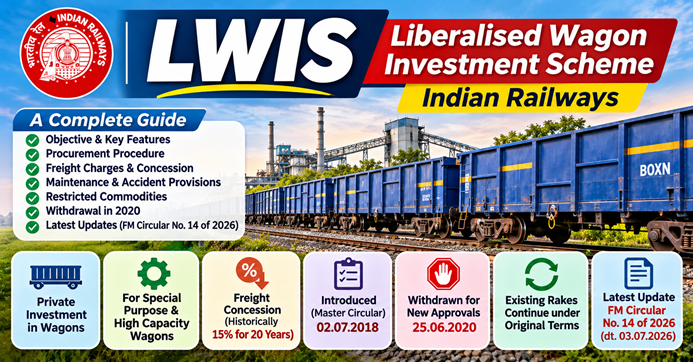
LWIS – Liberalised Wagon Investment Scheme in Indian Railways: Complete Guide, Rules, Freight Concession & Latest Updates (2026)
Last Updated: November 2026
The Liberalised Wagon Investment Scheme (LWIS) was introduced by Indian Railways to encourage private investment in railway wagons and improve the availability of specialised and high-capacity wagons for freight transportation.
Under this scheme, eligible investors could procure their own wagon rakes, including spare wagons and brake vans, and use them for the transportation of approved commodities over railway-approved routes or closed circuits.
LWIS was an important initiative for increasing private participation in railway freight operations, improving wagon availability and supporting the transportation requirements of industrial customers.
However, Indian Railways subsequently withdrew LWIS for new approvals on 25 June 2020, following the introduction of the Liberalised Special Freight Train Operator (LSFTO) Scheme.
Existing and previously approved LWIS rakes were permitted to continue under the original terms and conditions, subject to applicable subsequent amendments.
This article explains the objectives, procurement procedure, freight charges, concessions, maintenance responsibilities, restrictions, accident provisions and important Railway Board circulars relating to LWIS, including the latest amendment issued in July 2026.
Important Update (2026): LWIS is withdrawn for fresh approvals. Existing LWIS rakes continue under applicable policy conditions. Railway Board's FM Circular No. 14 of 2026 dated 03.07.2026 amended the Ground Usage Charge provisions applicable to LWIS.
1. What is LWIS in Indian Railways?
LWIS stands for Liberalised Wagon Investment Scheme.
It was a private wagon investment scheme under which eligible investors could procure Special Purpose Wagons (SPW) and High Capacity Wagons (HCW) for transporting approved commodities through Indian Railways.
The basic concept was to allow private investors to purchase wagons while Indian Railways facilitated their movement through the railway network, subject to approved routes, loading and unloading points and other policy conditions.
Main objectives of LWIS
To encourage private investment in railway wagons.
To improve the availability of specialised and high-capacity wagons.
To increase the freight transportation capacity of Indian Railways.
To meet the specific transportation requirements of industrial customers.
To improve the efficiency of freight movement.
To increase the participation of private players in railway freight transportation.
2. When was LWIS introduced?
The Liberalised Wagon Investment Scheme was introduced as part of Indian Railways' initiatives to attract private investment in freight wagons.
The revised policy was issued through:
Freight Marketing Master Circular/LWIS/2018/0
Railway Board Letter No. 2016/TC(FM)/4/12(LWIS)
Date: 02.07.2018
The scheme was subsequently amended through Railway Board circulars.
3. How does LWIS work?
Under LWIS, an investor was required to procure a rake or multiple rakes, including the prescribed spare wagons and brake van.
The investor procured the wagons directly from an approved wagon manufacturer or through import, subject to applicable Indian Railway Standards (IRS), approved designs and specifications and inspection requirements.
Indian Railways agreed to operate the privately procured rakes within the approved railway network, subject to the conditions of the scheme.
Each rake was assigned approved loading and unloading points over specified routes or closed circuits.
4. Procedure for procurement of wagons under LWIS
The procurement procedure under the scheme involved the following steps:
Step 1: Submission of application to COM
The investor approached the Chief Operations Manager (COM) of the Railway where loading was proposed.
The application included details such as:
Number of rakes required.
Type of wagons.
Commodity to be transported.
Proposed loading stations.
Proposed unloading stations.
Other operational details.
Step 2: Operational feasibility and NOC
The proposal was examined for operational feasibility.
After examination, the COM of the loading Railway and the concerned Railways through which the rake was proposed to operate issued the necessary No Objection Certificate (NOC), subject to operational feasibility.
Step 3: Railway Board approval
The investor's application, along with the NOCs, was forwarded by the Zonal Railway to the Executive Director, Freight Marketing (EDFM), for obtaining Railway Board approval for procurement of wagons under LWIS.
Step 4: Procurement of wagons
After obtaining the necessary approval, the investor procured the wagons directly from the wagon manufacturer or through import.
The wagons were required to comply with the prescribed IRS designs and specifications and were subject to inspection by RDSO.
Step 5: Approval of routes and terminals
Each rake was assigned authorised loading and unloading points over specified routes or closed circuits as approved by Indian Railways.
The approved loading and unloading points could be changed according to the investor's requirements, subject to the applicable approval procedure.
5. Freight charges under LWIS
Freight charges under the scheme were governed by the applicable Railway tariff and the relevant concession provisions.
The principal provisions were:
1. Normal freight charges
Freight was charged at the normal tariff applicable from time to time, subject to adjustment of the admissible freight concession.
2. Empty rake movement
No freight was charged for movement of empty rakes to the next destination, subject to the applicable distance condition.
However, where the empty rake travelled a distance greater than the loaded distance, empty freight was chargeable at 50% of the loaded traffic freight.
6. Freight concession under LWIS
One of the important incentives under LWIS was the freight concession offered to investors.
As per the scheme provisions supplied for this study:
Freight concession: 15% on the base freight rate.
Concession period: 20 years.
The concession was adjusted in the Railway Receipt (RR) itself.
The applicable concession was subject to the approved scheme conditions.
Important: Historical LWIS provisions distinguished between Special Purpose Wagons and High Capacity Wagons. The concession applicable to a particular rake should therefore be verified against its approved category and agreement rather than assuming that every historical LWIS rake had identical concession terms.
Restriction on double benefits
If an investor availed any other concession or financial benefit under another wagon procurement scheme, the freight concession under LWIS was not admissible as specified in the scheme.
7. Maintenance of wagons under LWIS
Under the LWIS provisions provided for this article:
The cost of maintenance of wagons was borne by the investor.
Haulage charges for moving the wagons from the private terminal to the workshop or maintenance depot and back to the loading point were borne by the Railways, subject to the scheme's terms.
The maintenance responsibilities and financial arrangements should be read with the applicable LWIS agreement.
8. Restricted commodities under LWIS
The scheme imposed restrictions on the transportation of certain commodities.
The following commodities were not permitted under the supplied LWIS provisions:
Coal
Coke
Ores and minerals, including Iron Ore
However, other commodities produced or consumed by the investor were permissible, subject to the applicable approval and policy conditions.
9. Wagons involved in accidents under LWIS
The scheme specified different compensation provisions depending on the responsibility for the accident.
Case 1: Accident due to negligence of investor
If wagons were condemned as a result of an accident attributable to the negligence of the investor, no compensation was payable by the Railways.
Case 2: Accident due to negligence of Railways
If wagons were condemned due to an accident attributable to the negligence of the Railways, compensation was payable by the Railways at the depreciated value calculated as per applicable Income Tax Rules at the time of condemnation.
10. Right of Railways to purchase wagons
If an investor decided to discontinue the operation of wagons under the scheme, Indian Railways had the first right to purchase those wagons.
Condemned wagons could be disposed of directly by the investor or through the Railways, subject to applicable provisions.
11. Important wagon investment schemes of Indian Railways
Indian Railways introduced several schemes to encourage private participation in freight wagon procurement and operation.
The following schemes are important for departmental examination preparation.
| S. No. | Scheme | Date of issue |
|---|---|---|
| 1 | Wagon Leasing Scheme (WLS) | 15.04.2008 |
| 2 | Liberalised Wagon Investment Scheme (LWIS) | 15.04.2008 |
| 3 | Special Freight Train Operator (SFTO) | 31.05.2010 |
| 4 | Private Freight Terminal (PFT) | 31.05.2010 |
| 5 | Development of Automobile & Ancillary Hub | 16.06.2010 |
| 6 | Automobile Freight Train Operator Scheme (AFTO) | 19.07.2010 |
Note: These are the historical dates provided in the study material. The individual policies have undergone subsequent changes.
12. Withdrawal of LWIS – Railway Board Circular dated 25 June 2020
One of the most important developments in the history of LWIS was its withdrawal for fresh approvals.
Railway Board issued Freight Marketing Circular No. 8 of 2020, dated 25.06.2020, vide Letter No. 2020/TC(FM)/4/4.
Why was LWIS withdrawn?
Indian Railways had introduced the Liberalised Special Freight Train Operator (LSFTO) Scheme for the induction of Special Purpose and High Capacity Wagons through private participation.
To avoid duplication of schemes, Railway Board decided to withdraw LWIS.
Important provisions of the withdrawal circular
No new approvals would be granted under LWIS.
Rakes already inducted and operating under LWIS would continue to operate.
Rakes already approved but awaiting induction could also be inducted by the concerned parties.
Such existing and approved rakes would continue under the same terms and conditions of LWIS.
Examination Point: LWIS was withdrawn for new approvals on 25 June 2020, but previously approved and operating rakes were not discontinued merely because of the withdrawal.
13. What is LSFTO? The replacement for LWIS
The Liberalised Special Freight Train Operator (LSFTO) Scheme was introduced by Indian Railways to facilitate private investment in Special Purpose and High Capacity Wagons.
The LSFTO Master Circular was issued through:
Railway Board Letter No. 2020/TC(FM)/04/02
Date: 16.03.2020
LSFTO was introduced to avoid duplication with the existing LWIS framework and provide an alternative mechanism for private participation in the induction of specialised and high-capacity wagons.
Therefore, while studying LWIS, candidates should also understand the basic purpose of LSFTO.
14. Latest LWIS Update – FM Circular No. 14 of 2026
This is the most important recent update for existing LWIS rakes.
Railway Board issued FM Circular No. 14 of 2026 on 03 July 2026.
Circular details:
Letter No.: 2020/TC(FM)/4/2
E-file reference: e-3362268
Date: 03.07.2026
Subject: Liberalization in LSFTO/GPWIS/SFTO/LWIS policies – levy of ground usage charges, transfer of ownership under GPWIS/SFTO/LSFTO, and signing of LSFTO Agreement.
The circular amended provisions of GPWIS, LSFTO, SFTO and LWIS.
What changed specifically for LWIS?
As per Annexure IV of FM Circular No. 14 of 2026, the following amendments were made to Annexure B of the LWIS Master Circular.
A. Amendment to Para 5.2.3.6
Earlier provision:
Ground Usage Charge was levied on a per-train-per-hour basis, irrespective of the number of goods on the ground.
Amended provision:
Ground Usage Charge will be levied at the prevailing rate of wharfage, as per the provisions in Chapter II of the Rates Master Circular on Demurrage/Wharfage Waiver/2016/0 dated 19.05.2016, together with subsequent amendments and corrigenda.
Important additional provision:
Ground Usage Charge shall not be leviable at:
Private Siding
Private Freight Terminal (PFT)
Gati Shakti Cargo Terminal (GCT)
B. Deletion of Para 5.2.3.7
The earlier provision relating to levy of Ground Usage Charge for the full rake at the prevailing wharfage rate was deleted.
Effective date
The amendments came into effect from 03.07.2026, the date of issue of the Railway Board circular.
Zonal Railways were advised to incorporate the amendments into the relevant rake agreements.
Important clarification about ownership transfer
FM Circular No. 14 of 2026 also removed specified national-security and public-interest-related restrictions in the ownership-transfer provisions of GPWIS, SFTO and LSFTO.
However, the LWIS-specific amendment in Annexure IV concerns Ground Usage Charges. The ownership-transfer amendments should not be incorrectly attributed to LWIS.
15. Comparison of important wagon investment schemes
| Scheme | Main purpose | Important status / feature |
|---|---|---|
| LWIS | Investment in Special Purpose and High Capacity Wagons | Withdrawn for new approvals; existing rakes continue |
| GPWIS | Investment in General Purpose Wagons such as BOX, BOXN and BCN | 10% freight rebate under the applicable policy |
| SFTO | Private investment in special-purpose wagons for identified commodities | Subject to the applicable SFTO policy |
| LSFTO | Private participation in induction of Special Purpose and High Capacity Wagons | Introduced in March 2020 |
| AFTO | Private investment in automobile-carrying wagons | Specialised automobile freight transportation |
Remember: The 10% freight rebate under GPWIS is different from the historical LWIS freight concession. Do not interchange these two schemes when answering examination questions.
16. Important Railway Board circulars for LWIS
| S. No. | Circular / Letter No. | Date | Subject |
|---|---|---|---|
| 1 | 2016/TC(FM)/4/12(LWIS) | 02.07.2018 | LWIS Master Circular 2018 |
| 2 | Freight Marketing Circular No. 28 of 2018 | 15.11.2018 | Amendment to LWIS |
| 3 | 2020/TC(FM)/4/4 | 25.06.2020 | Withdrawal of LWIS |
| 4 | 2020/TC(FM)/04/02 | 16.03.2020 | LSFTO Master Circular |
| 5 | 2020/TC(FM)/4/2 | 03.07.2026 | FM Circular No. 14 of 2026 – LWIS ground usage charge amendment |
17. LWIS – Important Questions and Answers for Railway Exams
Q1. What is the full form of LWIS?
Answer: Liberalised Wagon Investment Scheme.
Q2. What is the purpose of LWIS?
Answer: To encourage private investment in Special Purpose and High Capacity Wagons.
Q3. Which authority approves procurement of wagons under LWIS?
Answer: Railway Board, through the prescribed approval procedure.
Q4. Who is initially approached for operational feasibility?
Answer: Chief Operations Manager (COM) of the loading Railway.
Q5. Which organisation inspects the wagons?
Answer: Research Designs and Standards Organisation (RDSO).
Q6. Which commodities were restricted under the supplied LWIS provisions?
Answer: Coal, coke, ores and minerals, including Iron Ore.
Q7. What was the freight concession mentioned in the supplied LWIS study material?
Answer: 15% on base freight for the specified concession period, subject to applicable wagon category and agreement conditions.
Q8. What was the concession period mentioned?
Answer: 20 years.
Q9. When was LWIS withdrawn for new approvals?
Answer: 25 June 2020.
Q10. Which scheme was introduced as the alternative to LWIS?
Answer: Liberalised Special Freight Train Operator (LSFTO) Scheme.
Q11. Which circular withdrew LWIS?
Answer: Freight Marketing Circular No. 8 of 2020, dated 25.06.2020.
Q12. What is the Railway Board Letter No. of the LWIS Master Circular 2018?
Answer: 2016/TC(FM)/4/12(LWIS), dated 02.07.2018.
Q13. What is FM Circular No. 14 of 2026 related to?
Answer: Liberalisation of LSFTO, GPWIS, SFTO and LWIS policies, including amendments to Ground Usage Charges.
Q14. When was FM Circular No. 14 of 2026 issued?
Answer: 03 July 2026.
Q15. Under the 2026 amendment, where is Ground Usage Charge not leviable for LWIS?
Answer: Private Siding, PFT and GCT.
Q16. Which paragraph of the LWIS Master Circular was amended in relation to Ground Usage Charges in 2026?
Answer: Para 5.2.3.6 of Annexure B.
Q17. Which paragraph was deleted under the 2026 LWIS amendment?
Answer: Para 5.2.3.7 of Annexure B.
18. Quick Revision – LWIS at a Glance
| Particular | Important Answer |
|---|---|
| Full form | Liberalised Wagon Investment Scheme |
| Main objective | Private investment in railway wagons |
| Main wagon categories | Special Purpose and High Capacity Wagons |
| Master Circular | LWIS/2018/0 |
| Master Circular date | 02.07.2018 |
| Railway Board Letter No. | 2016/TC(FM)/4/12(LWIS) |
| Initial operational contact | COM of loading Railway |
| Wagon inspection | RDSO |
| Withdrawal date | 25.06.2020 |
| Withdrawal circular | FM Circular No. 8 of 2020 |
| Alternative scheme | LSFTO |
| LSFTO Master Circular | 16.03.2020 |
| Latest relevant amendment | FM Circular No. 14 of 2026 |
| Latest amendment date | 03.07.2026 |
| LWIS amended paragraph | Para 5.2.3.6, Annexure B |
| Deleted paragraph | Para 5.2.3.7, Annexure B |
Conclusion
The Liberalised Wagon Investment Scheme was an important initiative by Indian Railways to encourage private investment in Special Purpose and High Capacity Wagons.
Although LWIS was withdrawn for new approvals in June 2020, previously approved and inducted rakes were permitted to continue under the original policy conditions.
For railway departmental examinations, the most important areas are the procurement procedure, freight concession, restricted commodities, maintenance responsibilities, accident provisions, withdrawal of LWIS and the latest amendments introduced through FM Circular No. 14 of 2026.
For examination preparation, remember three important dates:
02 July 2018 – LWIS Master Circular.
25 June 2020 – Withdrawal of LWIS for new approvals.
03 July 2026 – Latest relevant amendment to LWIS Ground Usage Charges.
Continue your preparation with myCBT's Railway Commercial, Freight Marketing and Station Accounts Knowledge Booster questions and MCQ practice sets.
Official and reference documents
Freight Marketing Master Circular/LWIS/2018/0 – Railway Board Letter No. 2016/TC(FM)/4/12(LWIS), dated 02.07.2018.
Freight Marketing Circular No. 28 of 2018 – Amendment to LWIS.
Freight Marketing Circular No. 8 of 2020 – Withdrawal of LWIS, dated 25.06.2020.
Freight Marketing Master Circular/LSFTO/2020/0 – Railway Board Letter No. 2020/TC(FM)/04/02, dated 16.03.2020.
FM Circular No. 14 of 2026 – Railway Board Letter No. 2020/TC(FM)/4/2, dated 03.07.2026.
Disclaimer: This article is prepared for educational and departmental examination purposes. For actual operational, contractual or financial decisions, refer to the applicable Railway Board circulars, amendments, corrigenda and executed agreements.