MSOP 2018, or Model Schedule of Powers 2018, is an important reference for understanding the delegation of administrative and financial powers within Indian Railways.
For railway employees and aspirants preparing for departmental examinations, promotional examinations, railway management topics, and competitive examinations, MSOP is an important area because it explains who can exercise which powers, under what conditions, and within what delegated authority.
Quick Answer: MSOP stands for Model Schedule of Powers. The first MSOP was issued in October 2017, followed by the revised MSOP in July 2018. Its broad purpose is to establish a common framework for the delegation of powers to different railway officers and improve uniformity and efficiency in decision-making.
What is MSOP?
MSOP stands for Model Schedule of Powers.
It provides a framework for the delegation of powers to different levels of officers in Indian Railways.
Delegation means entrusting authority, power, and responsibility to another person—normally a subordinate officer or manager—to carry out specified activities.
In an organisation, delegation helps distribute work and decision-making responsibilities among different levels of officials.
The concept is particularly important in large organisations such as Indian Railways, where decisions have to be taken at headquarters, zonal, divisional, workshop, and other administrative levels.
When was MSOP introduced?
The timeline is:
October 2017: First MSOP issued.
July 2018: Revised MSOP issued.
The 2018 revision is commonly referred to as MSOP 2018 / Model SOP 2018.
Why was MSOP needed?
The Model Schedule of Powers was intended to support:
Setting up a benchmark for delegated powers.
Uniformity across Zonal Railways in implementation of decisions.
Simplification of procedures and work processes.
Better familiarity with rules and procedures for officers transferred from one railway to another.
These objectives are especially relevant because officers may be transferred between different Zonal Railways and need a consistent framework for exercising delegated powers.
What is delegation of powers?
Delegation of powers can be understood as the transfer of specified authority and responsibility from a higher level to a subordinate level.
In management terms, delegation involves:
Entrusting authority and responsibility.
Distributing work among members of an organisation.
Empowering officials to take decisions within defined limits.
Moving appropriate decision-making closer to the level where work is actually performed.
The source material describes delegation as one of the core concepts of management and leadership.
Who was responsible for the MSOP initiative?
MSOP was an initiative of the Railway Transformation Cell.
The Transformation Cell was constituted by the Railway Board on 9 March 2017. It was headed by a Principal Executive Director, with nodal executive directors drawn from different disciplines including Traffic, Engineering, Mechanical, Electrical, S&T, Personnel and Accounts.
The source material identifies the Model SOP as one of the achievements of the Transformation Cell, particularly in relation to the delegation of more powers to DRMs and other branch officers.
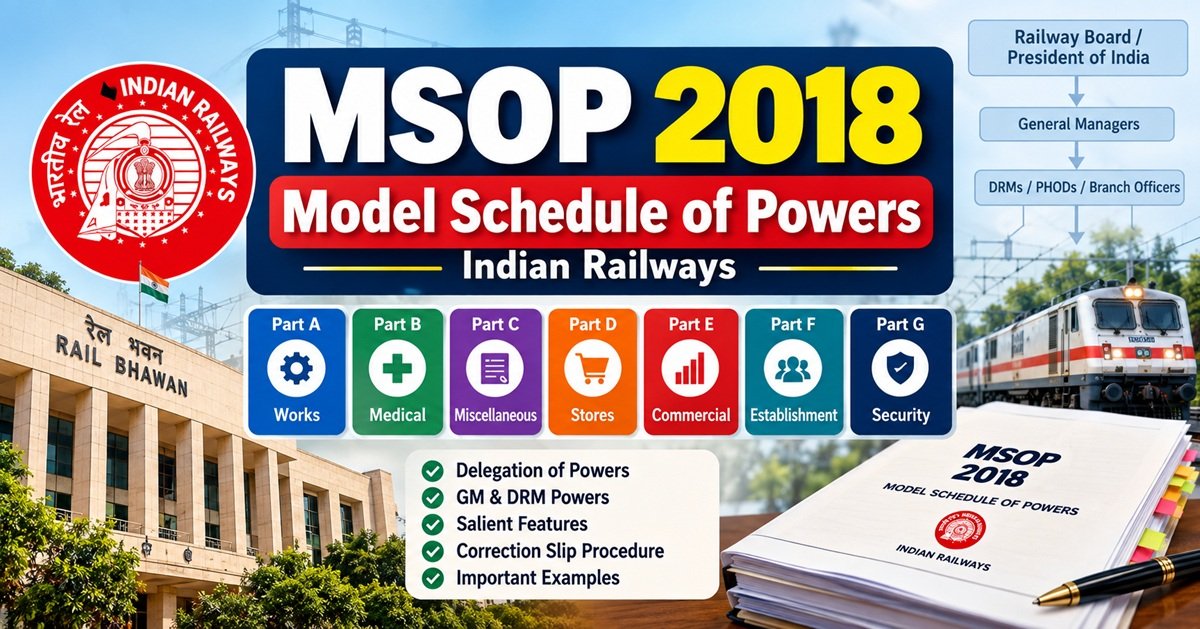
MSOP 2018 Parts: A to G
One of the most important facts for examination preparation is the structure of MSOP.
| Part | Subject |
|---|---|
| Part A | Works |
| Part B | Medical |
| Part C | Miscellaneous |
| Part D | Stores |
| Part E | Commercial |
| Part F | Establishment — Gazetted & Non-Gazetted |
| Part G | Security |
The source material lists these seven parts explicitly.
What are the annexures in MSOP?
The source material identifies two important annexures:
| Annexure | Delegation |
|---|---|
| Annexure 1 | Delegation of Powers to GMs |
| Annexure 2 | Delegation of Powers to GMs & DRMs |
What are the salient features of MSOP 2018?
Important features mentioned in the source material include:
The document runs to approximately 420 pages.
Additional delegation can be made according to local requirements.
More powers were delegated to DRMs and Branch Officers, including Station Directors.
Where no PHOD is posted, the CHOD can exercise the powers of PHOD.
The AGM can exercise the powers of GM, except where personal sanction of the GM is specifically required.
Miscellaneous matters include areas such as CTIs, IT and PR.
Part G contains the SOP for RPF, including the latest delegations for RPF referred to in the 2018 material.
Powers delegated to DRMs are generally the same for CWMs in SAG.
PCSCs of RPF exercise the powers available to PHODs for matters concerning them.
ADRMs in NFSAG exercise the same powers as ADRMs in SAG.
Senior Scale independent-charge branch officers exercise powers available to divisional officers in JAG/SG.
Station Directors and Administrators of Central Hospitals in JAG/SG exercise powers available to Branch Officers.
Where finance concurrence is not required, this is specifically mentioned; where nothing is mentioned, finance concurrence is to be presumed.
What are the powers of a GM under the MSOP framework?
A particularly important concept is that some GM powers in the Indian Railways Finance Code, Volume I, Chapter V, Annexure II are expressed in a negative form.
The source material explains the principle as:
Powers are stated in terms of matters that can be done without previous sanction of the higher authority, namely the Railway Board.
Therefore, a negative formulation needs to be interpreted carefully.
Example
If a provision refers to granting a reward in excess of ₹5,000, the interpretation given in the source material is that the GM's delegated power extends up to ₹5,000 per individual case, rather than authorising rewards above that amount.
This distinction between the wording of a provision and the practical limit of delegated authority is an important MSOP examination concept.
Important examples of delegation under MSOP 2018
The source material gives several examples of changes in delegated powers.
| Matter | Existing Delegation | Revised Delegation |
|---|---|---|
| Consultancy contracts | ₹1 crore per case | No limit |
| Staff welfare — Plan Head 5 | ₹20 lakh per case | ₹1 crore per case |
| Ceremonial occasions | ₹2 lakh per case | ₹5 lakh per case |
| Software development | No powers | ₹2.5 crore per case |
| Zonal contract | ₹2 lakh | ₹5 lakh |
| Outsourcing of P.Way activity | GM | DRMs |
| Licensing of railway land for sidings | No powers | DRMs |
| Passenger facilities by trusts/private persons | GM | DRM |
| New UTS-cum-PRS | GM | DRM |
| Earning contracts | PHOD above ₹15 crore; DRM up to ₹15 crore | Full powers |
| Refund of fares | ₹20,000 | Full powers |
| Service contracts | DRM ₹20 crore | DRM ₹100 crore |
| GM & DRM tour programmes within India | Approval required | Approval not required |
| Inter-Railway/Inter-Divisional transfers | — | Full powers to DRMs |
These figures are reproduced from the supplied MSOP study material and should be checked against the applicable Railway Board orders/correction slips before being used for a current administrative decision.
What is the role of a Branch Officer?
A Branch Officer is an officer in the division who directly reports to the DRM and is treated as being in independent charge for the relevant purposes.
The 2018 source material also connects the powers of Branch Officers with Station Directors and Administrators of Central Hospitals in JAG/SG.
What are the sources of MSOP?
The source material identifies three principal sources:
Indian Railways Codes and Manuals
Circulars issued by various Directorates, including Commercial and Transformation Cell
GM's negative powers under Annexure II to Chapter V of the Indian Railways Finance Code, Volume I
How are correction slips to MSOP issued?
The procedure described in the source material is:
The concerned PHOD initiates the proposal for correction.
DGM(G) acts as the nodal officer for MSOP.
The proposal received from the PHOD is examined by DGM(G) and processed for finance concurrence.
After finance concurrence, the draft correction slip is vetted.
DGM(G) issues the Correction Slip/Corrigendum with the personal approval of the GM.
In the case of direct delegation, a correction may also be issued without the consent of the department.
Corrections may also be issued by the Railway Board.
MSOP 2018: Quick Revision Table
| Question | Answer |
|---|---|
| What does MSOP stand for? | Model Schedule of Powers |
| First MSOP issued when? | October 2017 |
| Revised MSOP issued when? | July 2018 |
| MSOP has how many main parts? | 7 — A to G |
| Part A deals with? | Works |
| Part B deals with? | Medical |
| Part C deals with? | Miscellaneous |
| Part D deals with? | Stores |
| Part E deals with? | Commercial |
| Part F deals with? | Establishment |
| Part G deals with? | Security |
| Nodal officer for MSOP? | DGM(G) |
| Who can exercise PHOD powers if no PHOD is posted? | CHOD |
| MSOP initiative? | Railway Transformation Cell |
Frequently Asked Questions about MSOP
What is MSOP in Indian Railways?
MSOP means Model Schedule of Powers. It provides a framework for delegation of powers among different levels of railway officers.
When was MSOP 2018 issued?
The first MSOP was issued in October 2017, and the revised MSOP was issued in July 2018.
What are the seven parts of MSOP?
The seven parts are Works, Medical, Miscellaneous, Stores, Commercial, Establishment and Security, corresponding to Parts A through G.
What is Part E of MSOP?
Part E deals with Commercial matters.
What is Part F of MSOP?
Part F deals with Establishment matters, covering Gazetted and Non-Gazetted establishment.
What is Part G of MSOP?
Part G deals with Security matters and includes the RPF-related SOP described in the 2018 material.
Who is the nodal officer for MSOP?
The source material identifies DGM(G) as the nodal officer for MSOP.
What is the purpose of MSOP?
Its stated purposes include establishing a benchmark, promoting uniformity across Zonal Railways, simplifying procedures, and improving familiarity with rules and procedures for transferred officers.
MSOP 2018 for Railway Exam Preparation
For exam preparation, focus first on these high-frequency facts:
1. MSOP = Model Schedule of Powers
2. First MSOP = October 2017
3. Revised MSOP = July 2018
4. Part A = Works
5. Part B = Medical
6. Part C = Miscellaneous
7. Part D = Stores
8. Part E = Commercial
9. Part F = Establishment
10. Part G = Security
11. Nodal officer = DGM(G)
12. If no PHOD is posted, CHOD can exercise PHOD powers.
These points are also reflected in myCBT's existing MSOP Knowledge Booster material, making this article suitable as a reference page for related practice questions.
Important Note
MSOP provisions can be affected by subsequent Railway Board orders, correction slips, circulars, and amendments. Therefore, this article should be treated as a study and revision resource, not as a substitute for the latest applicable official order when exercising administrative or financial powers.
Conclusion
The Model Schedule of Powers 2018 is fundamentally about delegation of authority and responsibility within Indian Railways.
For learners, the most important areas are the A-to-G structure of MSOP, delegation of powers to GMs and DRMs, negative powers of GMs, the role of DGM(G), correction-slip procedure, and important examples of revised delegation.
Use this page as your MSOP reference guide, then reinforce the concepts with MSOP MCQs and Knowledge Booster quizzes on myCBT.